- Published on
Sakana AI & UC Berkeley MASS: Recursive Self-Improvement from Scratch
- Authors

- Name
- Hoang Nguyen
👤 1. Who Is Involved & Impacted?
- Creators: Researchers from Sakana AI and UC Berkeley (Hyunin Lee, Jinglue Xu, Jeffrey Seely, Donghyun Lee, Somayeh Sojoudi, Matei Zaharia, and Yujin Tang,
arXiv:2610.12176). - Base Model Under Test:
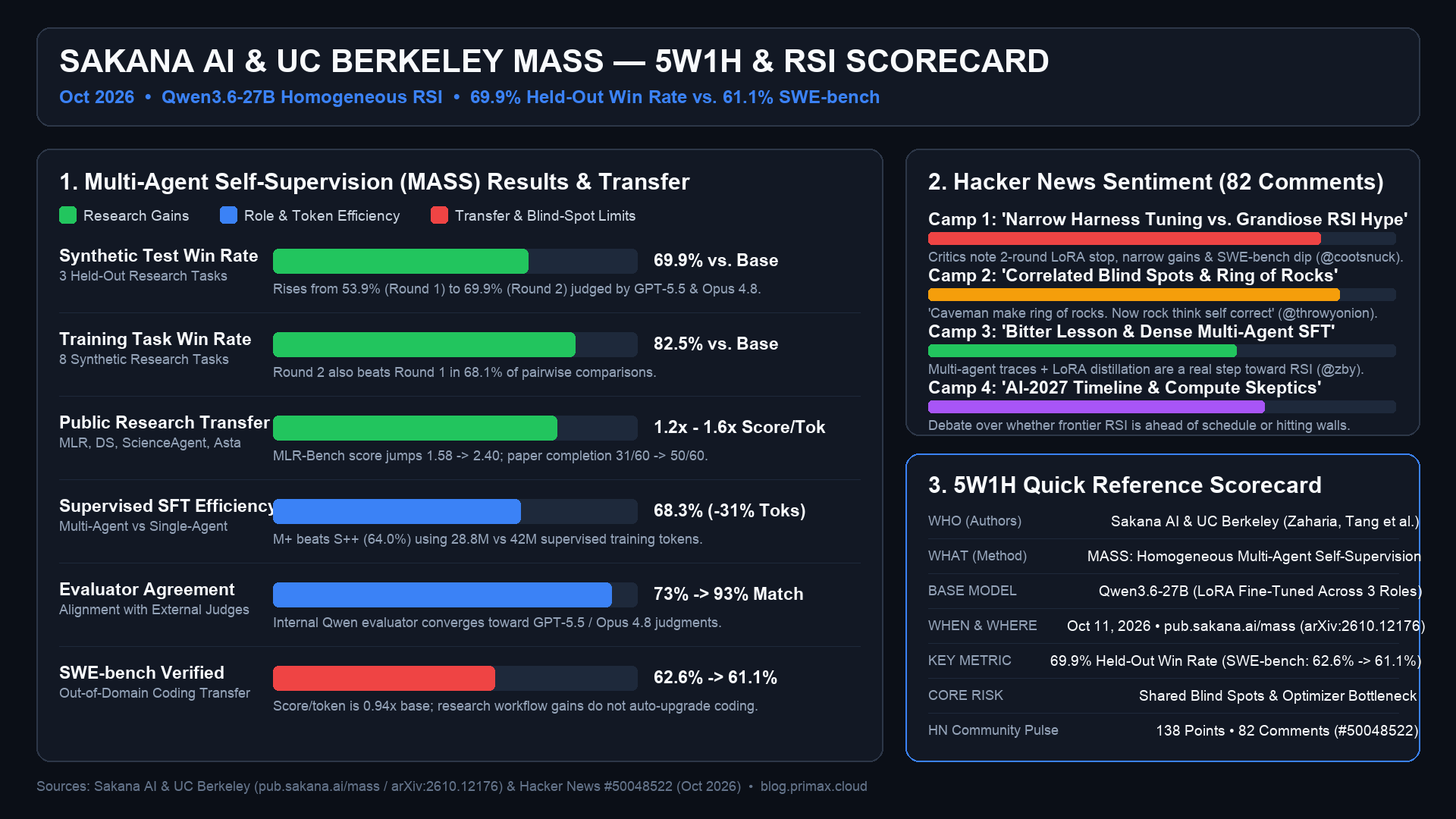
Qwen3.6-27Btrained in a strictly homogeneous loop where the optimizee is the evaluator, and the optimizer is the optimizee (via LoRA SFT without distilling from larger external frontier models). - Community: Discussed on Hacker News (138 points, 82 comments), debating whether distilling multi-agent traces back into the same checkpoint is true Recursive Self-Improvement (RSI) or bounded harness tuning.
📦 2. What Did They Build?
Multi-Agent Self-Supervision (MASS) repeatedly optimizes multi-agent workflows and distills that collective intelligence back into a single base model:
- Three Roles, One Shared Checkpoint (
L^(0) -> L^(1) -> L^(2)): A singleQwen3.6-27Bmodel acts simultaneously as the Workflow Optimizer, Multi-Agent Worker, and Internal Evaluator. - Synthetic Task Win Rates (Table 1):
- 8 Training Tasks: Win rate vs. base (
L^(0)) rises from65.6%(Round 1) to82.5%(Round 2). - 3 Held-Out Test Tasks: Win rate climbs from
53.9%(Round 1) to69.9%(Round 2).
- 8 Training Tasks: Win rate vs. base (
- Public Benchmark Transfer (
1.2x–1.6xScore/Token):- Evaluated without a multi-agent harness at test time, Round 2 (
L^(2)) achieves1.2x–1.6xscore per output token onMLR-Bench(1.58 -> 2.40),DSBench,ScienceAgentBench, andAstaBench. - Token Efficiency: Multi-agent SFT (
M+) reaches a68.3%win rate using 28.8M tokens (-31%fewer tokens) vs.64.0%for single-agent SFT (S++, 42M tokens).
- Evaluated without a multi-agent harness at test time, Round 2 (
📅 3. When & Where?
- When: Published on October 11, 2026.
- Where: Interactive blog at pub.sakana.ai/mass, paper on arXiv:2610.12176, and Hacker News Thread #50048522.
🎯 4. Why Does This Matter (and Why Did SWE-bench Dip)?
- Amortizing Multi-Agent Deliberation: Multi-agent debate beats a single forward pass but burns extra inference tokens. MASS compresses those multi-agent gains back into single-pass weights (
1.2x–1.6xscore/token). - Out-of-Domain Coding Regression: Self-supervision on scientific research tasks did not transfer to repository-level coding:
SWE-bench Verified(500 x 3): Dips from0.626(L^(0)) to0.618(L^(1)) and0.611(L^(2)).Terminal-Bench 2.0(89 x 3): Dips from0.375(L^(0)) to0.352(L^(2)).
- Correlated Blind Spots: Because Optimizer, Workers, and Evaluator share the same
Qwen3.6-27Bpriors, shared hallucinations cannot be self-corrected without external compilers/verifiers, causing gains to saturate after 2 rounds.
⚙️ 5. Benchmark Summary & Community Reaction
| Benchmark / Metric | Base (L^(0)) | Round 1 (L^(1)) | Round 2 (L^(2)) | Takeaway |
|---|---|---|---|---|
| 8 Training Tasks | Baseline | 65.6% win | 82.5% win | Strong in-domain distillation |
| 3 Held-Out Tasks | Baseline | 53.9% win | 69.9% win | Transfers to unseen research tasks |
| Public Research Suites | 1.0x | ~1.3x | 1.2x–1.6x score/tok | Higher token density at test time |
SWE-bench Verified | 0.626 | 0.618 | 0.611 (-1.5%) | Regresses on out-of-domain repo coding |
- Harness Tuning vs. RSI (
@cootsnuck): Saturating after 2 LoRA rounds with aSWE-benchdrop (0.626 -> 0.611) shows convergence to a local optimum, not open-ended RSI. - "Ring of Rocks" (
@throwyonion): Homogeneous self-evaluation amplifies shared priors unless anchored by a ground-truth environment or compiler. - Dense Synthetic Data (
@zby): Multi-agent rollouts (28.8Mvs.42Mtokens) remain a practical way to generate higher-signal SFT trajectories.
✅ CONCLUSION
MASS is best understood as multi-agent trajectory distillation (1.2x–1.6x score per token and 31% fewer training tokens) rather than unbounded self-improvement—proving that models grading themselves quickly hit a ceiling without external verifiers.