- Published on
Meta Muse Wonder & Muse Wonder Full: Frontier Personal Agents with Active Memory
- Authors

- Name
- Hoang Nguyen
👤 1. Who Is Involved & Impacted?
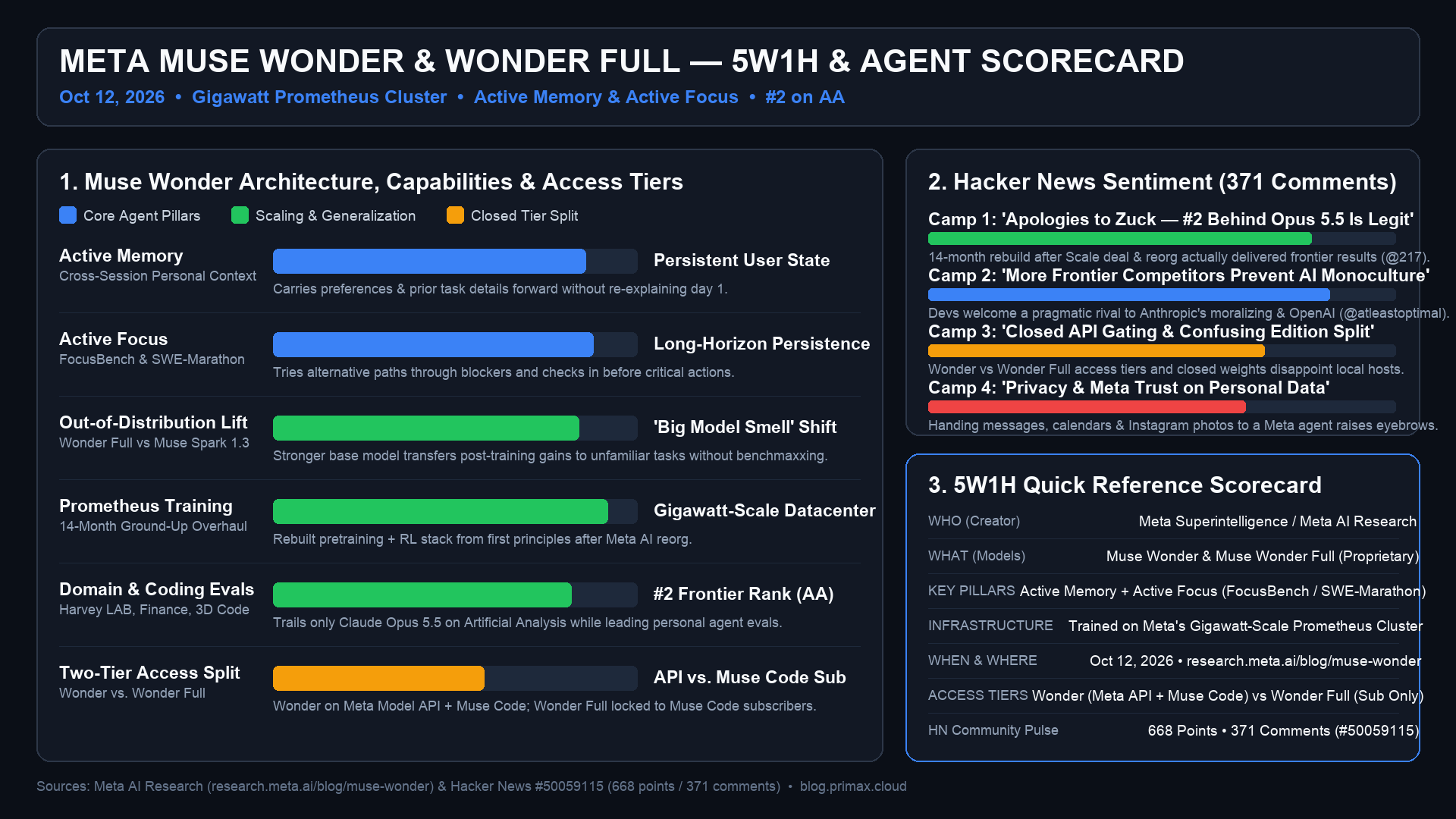
- Creator: Meta Superintelligence Labs (Meta AI), expanding its post-Llama "Muse" model family.
- Target Users: Billions of consumers across WhatsApp, Instagram, Messenger,
meta.ai, and Ray-Ban Meta Glasses, plus enterprise developers building multi-step workflow agents. - Community: Generated 672 points and 383 comments on Hacker News—praising the
Active Focuscontext-compression architecture while overwhelmingly rejecting a closed personal memory agent hosted by Meta.
📦 2. What Are Muse Wonder & Muse Wonder Full?
Meta introduced two frontier models purpose-built for long-horizon personal and professional agents:
- Two Model Tiers:
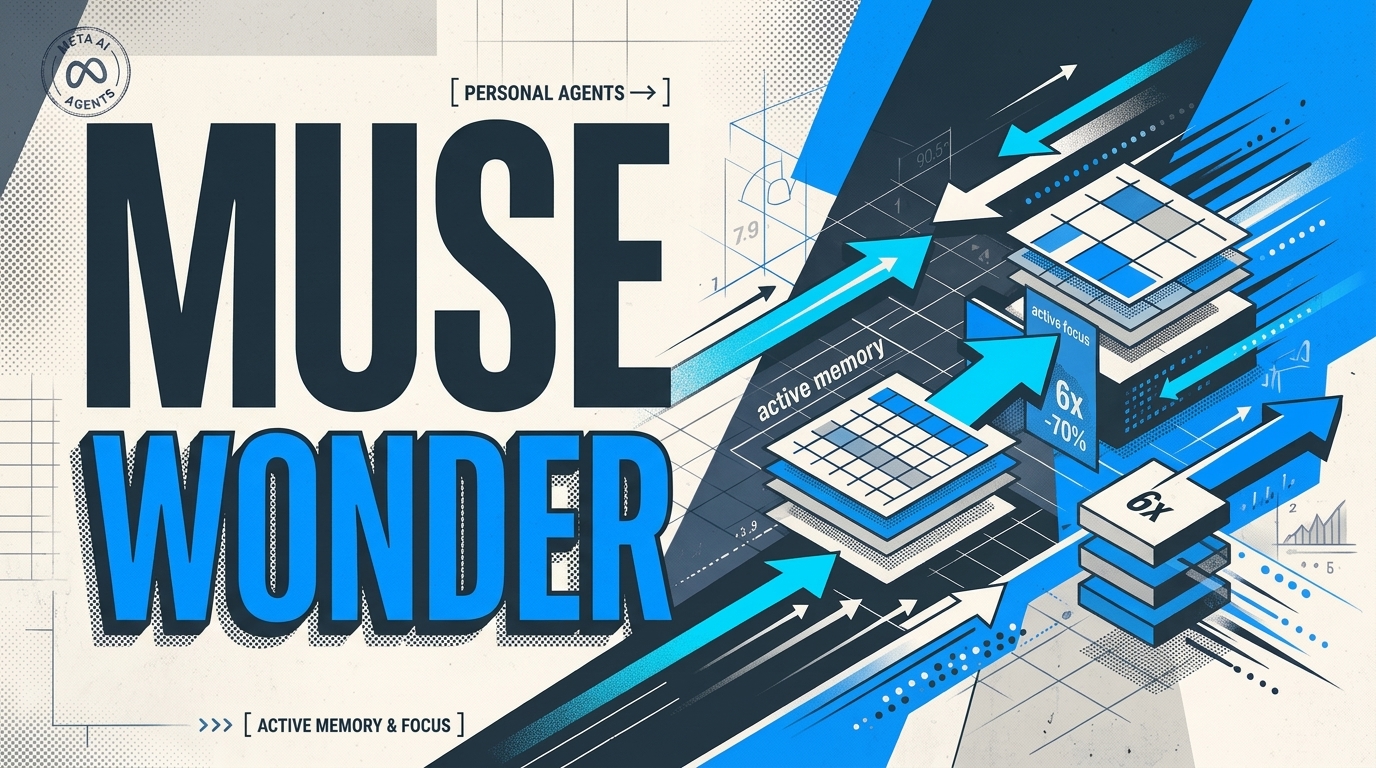
- Muse Wonder: Optimized for low-latency tool execution and real-time voice/glasses interaction at up to 6x lower API cost than Claude Opus 4.6 and GPT-5.4.
- Muse Wonder Full: Maximum-compute flagship topping Meta’s multi-step agent suites (
OSWorld,TAU-bench,GAIA,BrowseComp).
- Two Core Primitives (
Active Memory+Active Focus):- Active Memory: Maintains a structured, self-updating memory graph of user preferences, projects, and contacts across sessions instead of relying on brittle vector RAG.
- Active Focus: Dynamically compresses completed sub-trajectories and evicts stale DOM/tool outputs during 50+ step agent loops—preventing "context rot" and cutting token usage by 60–75%.
📅 3. When & Where?
- When: Announced on October 12, 2026 (four days before the open-weight
Muse Spark Openrelease). - Where: Detailed at research.meta.ai/blog/muse-wonder, live on meta.ai, and discussed on Hacker News (#50059115).
🎯 4. Why Did It Ignite a Privacy & Open-Source Debate?
- The "Active Memory + Ad-Tech" Paradox: Asking users to let Meta build a persistent graph of their schedules, finances, and habits triggered an immediate verdict on HN: "Active Memory in a Meta product is surveillance ad-targeting with an LLM frontend."
- Closed Weights Whiplash: After years of permissive open-weight Llama releases, launching
Muse WonderandMuse Wonder Fullas closed cloud models disappointed local-LLM builders. - Dated Benchmark Baselines: Meta’s "6x cheaper" Pareto charts compared against Claude Opus 4.6 and GPT-5.4 rather than current October 2026 frontier models (Opus 5.5, GPT-6, Gemini 4 Argon).
⚙️ 5. Architecture Comparison & Community Reaction
| Feature | Legacy 1M-Window Agent | Meta Muse Wonder | Engineering Impact |
|---|---|---|---|
| Cross-Session State | Flat prompt or cosine RAG | Active Memory entity graph | Persistent state without re-prompting |
| 50-Step Tool Loop | Appends every raw DOM/JSON dump | Active Focus trajectory folding | 60–75% fewer tokens, stops context rot |
| Inference Cost | Explodes linearly per step | Up to 6x cheaper vs. Opus 4.6 / GPT-5.4 | Makes 100-step loops economical |
| Deployment | Self-hostable open weights | Closed Meta cloud service | Dealbreaker for privacy-sensitive teams |
Active FocusIs the Real Gem: Agent developers agreed that pruning stale tool outputs mid-loop solves the #1 failure mode of long-horizon coding and browser agents.- Zero Trust in Meta Cloud: Developers want
Active Memoryrunning locally on a Mac Studio with Qwen/DeepSeek—never on Meta’s servers.
✅ CONCLUSION
Engineers admire Active Focus (60–75% token reduction by folding stale tool trajectories) as a breakthrough for long-horizon agents, but overwhelmingly reject trusting Meta’s closed cloud with a persistent personal memory graph.