- Published on
Remembering Margaret Hamilton (1936–2026): The Pioneer Who Made Software Engineering a Discipline
- Authors

- Name
- Hoang Nguyen
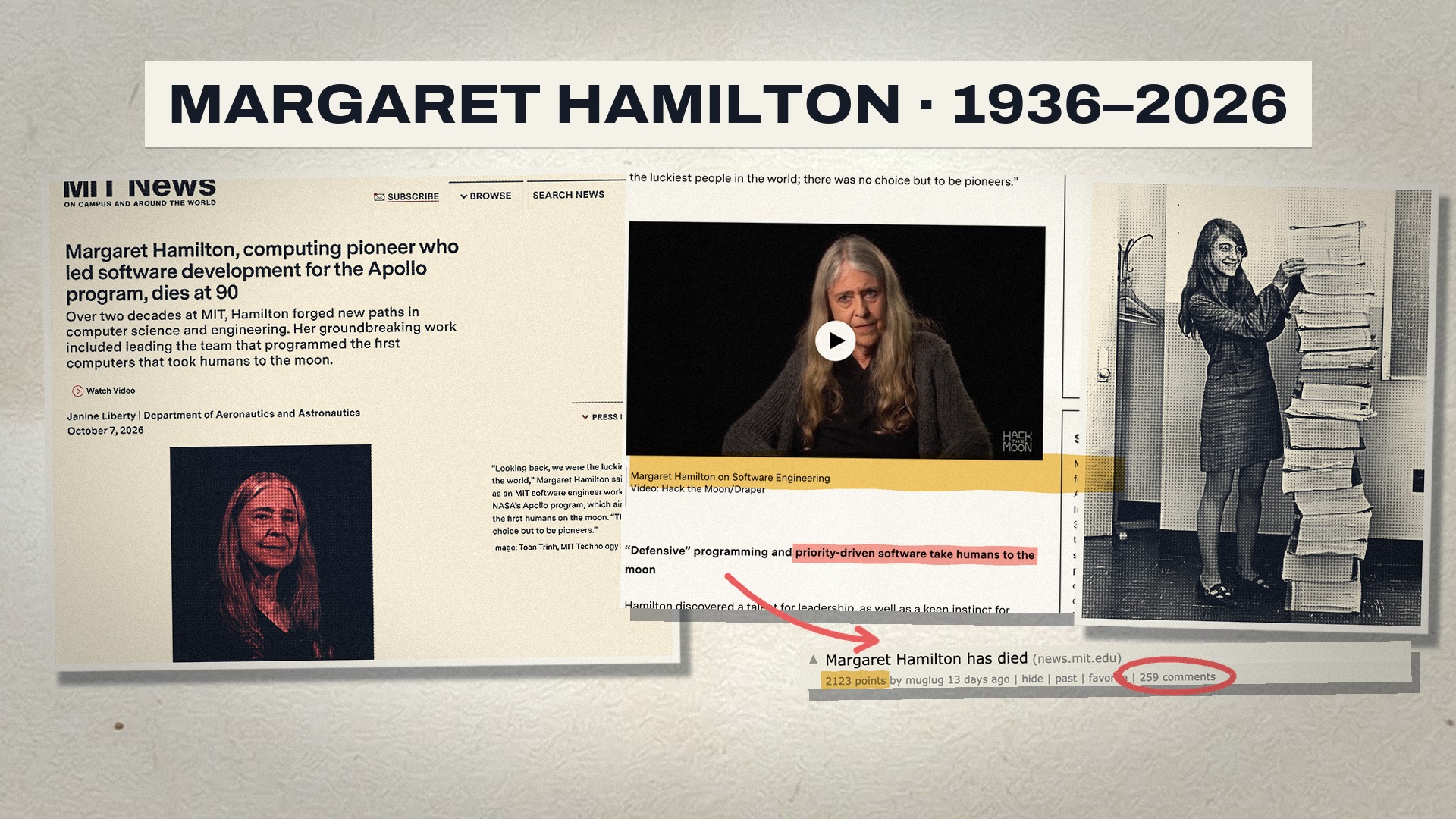
👤 1. Who Was Margaret Hamilton?
- The Pioneer: Margaret Heafield Hamilton (
1936–2026, aged 89), mathematician, computer scientist, and systems engineer. - MIT Instrumentation Lab Director: Led the Software Engineering Division that built the onboard flight software for the Apollo Command Module, Lunar Module, and Skylab.
- Founder & Theorist: Founded Higher Order Software (1976) and Hamilton Technologies (1986), pioneering the Universal Systems Language (USL) and Development Before the Fact (DBTF).
- Honors: Received the NASA Exceptional Space Act Award (2003) and the Presidential Medal of Freedom (2016).
📦 2. What Did She Build & Discover?
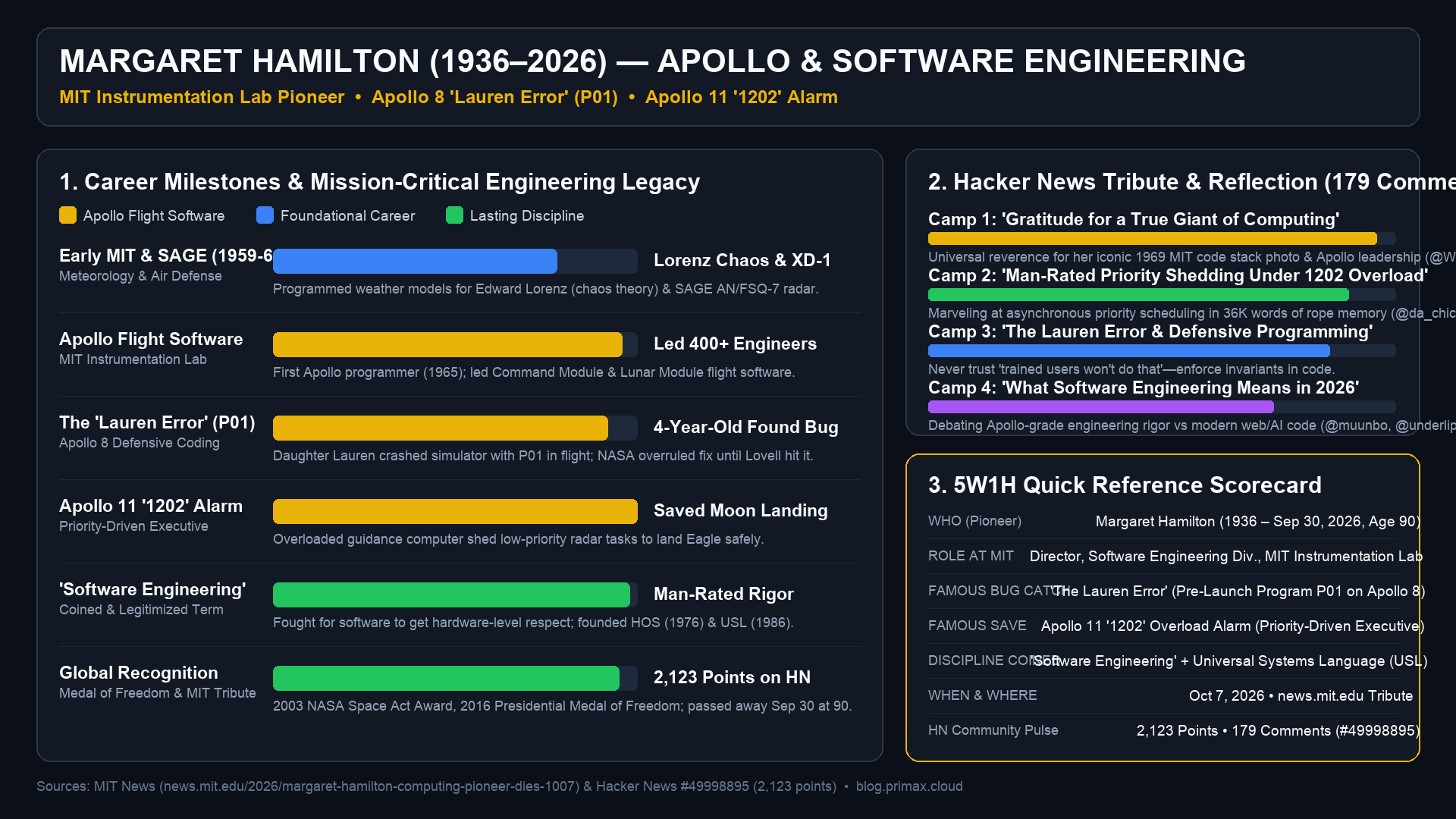
- Coined "Software Engineering": In the early 1960s, software was treated as clerical work secondary to hardware. Hamilton coined "Software Engineering" at MIT to demand rigorous systems discipline for flight code.
- The "Lauren Error" (
P01Safeguard):- Her 4-year-old daughter Lauren accidentally triggered the
P01prelaunch program mid-simulation at MIT, wiping navigation data. - NASA rejected Hamilton's request for a code interlock, claiming "astronauts are trained never to make that mistake."
- On Apollo 8, astronaut Jim Lovell accidentally selected
P01in flight, erasing orientation data and requiring an emergency patch. NASA let Hamilton add hardware/software interlocks immediately after.
- Her 4-year-old daughter Lauren accidentally triggered the
- Saved the Apollo 11 Landing (
1202/1201Alarms):- Three minutes before lunar touchdown, a misplaced radar switch flooded the Apollo Guidance Computer (AGC) (
2 KB RAM,36K words ROM) with spurious interrupts (13%CPU load). - Instead of crashing, the priority-driven asynchronous executive designed by Hamilton, Hal Laning, and Fred Martin triggered
1202/1201alarms—dropping low-priority radar displays while keeping thruster and landing guidance alive in real time.
- Three minutes before lunar touchdown, a misplaced radar switch flooded the Apollo Guidance Computer (AGC) (
📅 3. When & Where?
- When: MIT News announced her passing on October 7, 2026 (her Apollo work spanned 1961–1972).
- Where: Published by MIT News and honored in the week's #1 Hacker News thread (2,123 points, 259 comments).
🎯 4. Why Does Her Work Still Resonate?
- Fault Tolerance on 72 KB of Wire-Woven Memory: While modern multi-gigabyte apps crash on a single API timeout, Hamilton’s team built a preemptive real-time kernel inside 72 KB of hand-woven copper-wire core rope memory (
LOL memory) that survived an interrupt flood 3,000 feet above the Moon. - Preventing Bugs by Construction: Analyzing Apollo anomalies, she found 73% of systems errors were interface and timing bugs preventable before runtime—foreshadowing formal verification, Rust’s borrow checker, and TLA+.
- Iconic Trailblazer: Her 1969 photo standing beside a stack of AGC source code taller than her (
5 ft 6 in) inspired generations of women and engineers to enter computing.
⚙️ 5. Core Engineering Lessons & Community Reaction
| Principle | Apollo Guidance Computer (1969) | Modern Systems Lesson |
|---|---|---|
| Scheduling | Priority-driven asynchronous executive (7 jobs) | Never let noisy telemetry starve critical control loops |
| Overload | 1202 / 1201 graceful load shedding | Fail-operational recovery beats fatal kernel panic |
| UX Defense | The "Lauren Error" (P01) lesson | User error under stress is a systems design bug |
| Hardware | 2 KB RAM + 36K words ROM @ 1.024 MHz | Architecture matters infinitely more than raw compute |
- Honoring the Full MIT IL Team: HN commenters celebrated Hamilton alongside Hal Laning (AGC Executive architect), Don Eyles (Lunar Module descent code), and the women of Raytheon who wove every bit into magnetic core rope by hand.
- The Ultimate UX Parable: Engineers cited Lauren’s
P01crash as the clearest proof in history that guardrails belong in state machines, not user manuals.
✅ CONCLUSION
Every time we put "Software Engineer" on a resume or design a system to degrade gracefully instead of crashing, we stand on Margaret Hamilton’s shoulders.