- Published on
Meta Muse Spark Open (816B-A42B): US Open Weights vs. Chinese Rivals
- Authors

- Name
- Hoang Nguyen
👤 1. Who Is Involved & Impacted?
- Creator & Ecosystem Partners: Meta AI Research, partnering at launch with the PyTorch (
Helion), SGLang, vLLM, Apple ML Research (MLX), Hugging Face, NVIDIA, AMD, and Unsloth teams (🖥️ an oversized AI accelerator chip stamped with Meta's logo). - Direct Open-Weight Rivals: Leading Chinese open-weight frontier models—specifically DeepSeek-V4.1-Flash-1017, Z.ai GLM-5.3 / GLM-5.3 Flash, Alibaba Qwen 3.8 Flash Next, and Moonshot Kimi K3.
- Target Audience: AI infrastructure engineers, enterprise self-hosters, and high-end local cluster builders running multi-GPU servers or multi-node Apple M5 Ultra Mac Studio setups.
📦 2. What Is Meta Muse Spark Open?
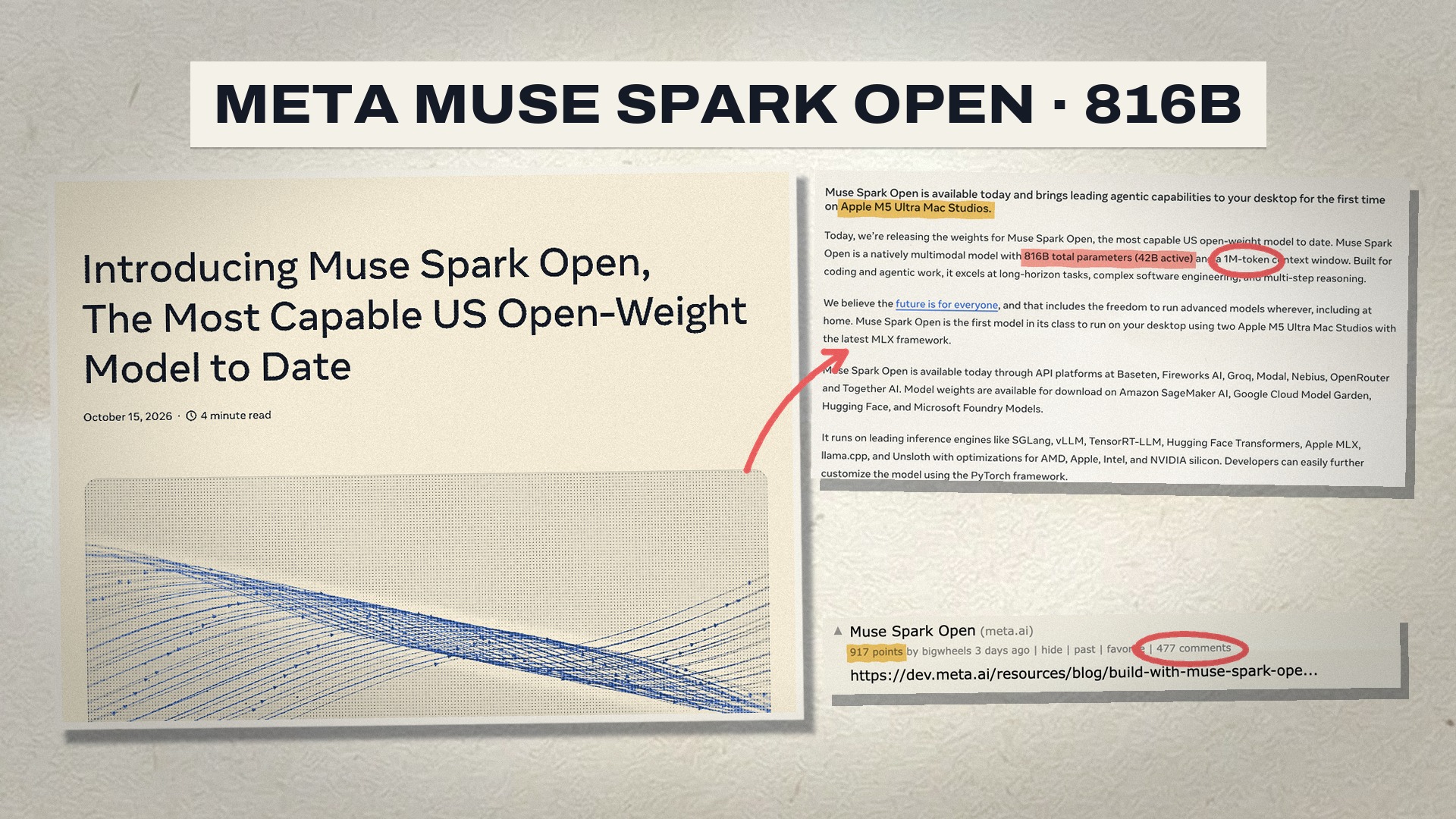
Billed by Meta as "The Most Capable US Open-Weight Model to Date," Muse Spark Open (meta-models/Muse-Spark-Open-816B-A42B) is the open-weight sibling of Meta's proprietary Muse Spark model:
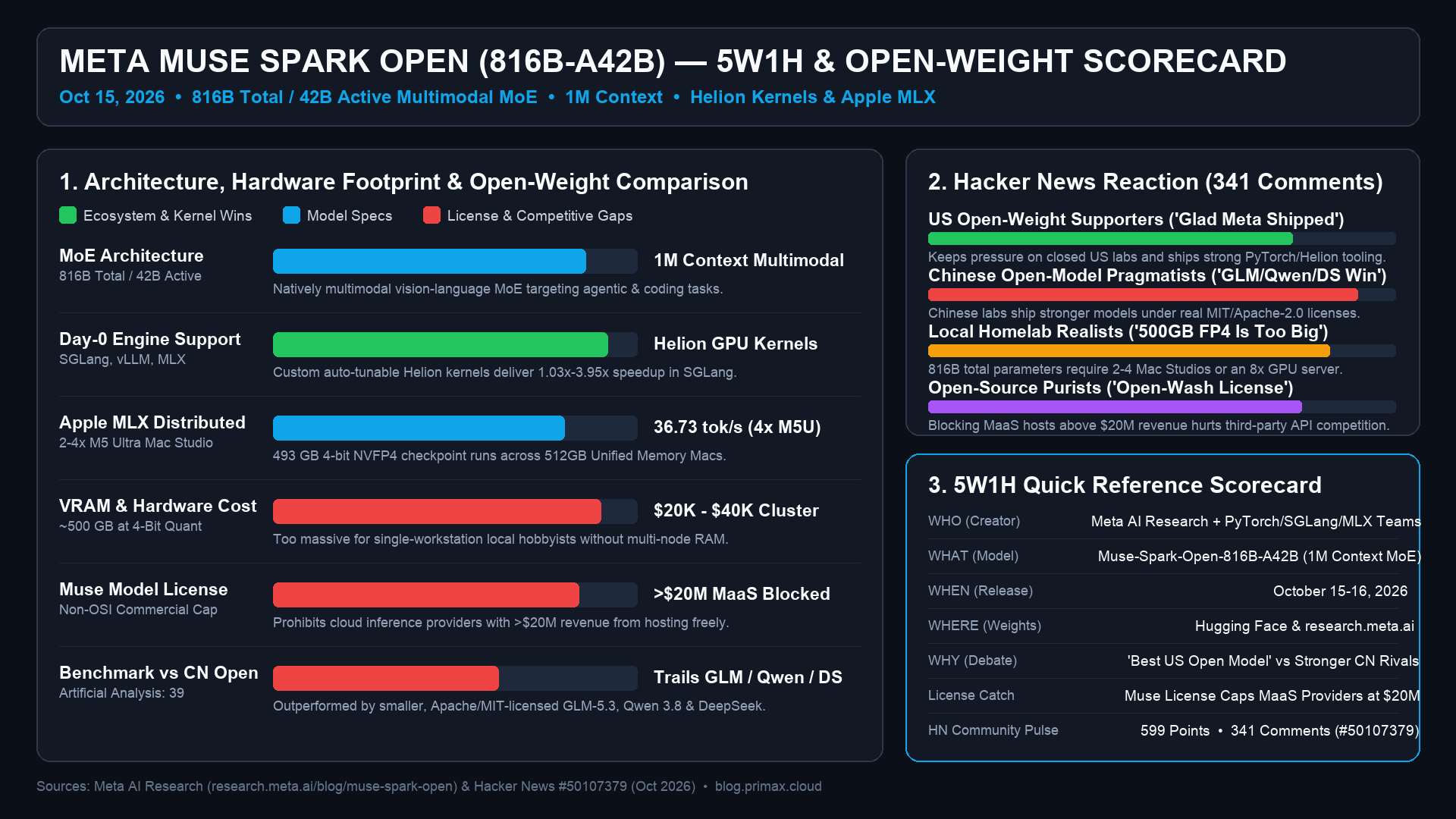
- 816B Total / 42B Active Multimodal MoE: A natively multimodal (vision + text) Mixture-of-Experts architecture with 816 billion total parameters, 42 billion active parameters per token, and a 1,000,000-token context window aimed at coding and agentic workflows.
- Custom
HelionAuto-Tuned GPU Kernels: Ships with custom Helion PyTorch kernels integrated directly into SGLang, delivering 1.03x to 3.95x kernel speedups over default Triton/CUDA implementations on Hopper and Blackwell GPUs. - Distributed Apple
MLXAcross M5 Ultra Mac Studios: In collaboration with Apple Machine Learning Research, Meta showcased distributed tensor-parallel inference over Thunderbolt 5 across 2 to 4 M5 Ultra Mac Studios (up to512 GBunified memory and1.2 TB/smemory bandwidth per node), hitting 36.73 tok/s (493 GBfootprint in 4-bitNVFP4) across a 4-node M5 Ultra cluster. - The Custom "Muse Model License" Catch: Instead of an OSI-approved Apache-2.0 or MIT license, Meta released the weights under the Muse Model License, which prohibits Model-as-a-Service (MaaS) inference providers with
>$20Min annual gross revenue from hosting the model without a separate commercial agreement from Meta.
📅 3. When & Where?
- When: Released on October 15–16, 2026, following Meta's proprietary Muse Spark announcement earlier in the month.
- Where: Published on research.meta.ai/blog/muse-spark-open and Hugging Face (
meta-models/Muse-Spark-Open-816B-A42B), sparking Hacker News (#50107379) with 599 points and 341 comments.
🎯 4. Why Did This Spark Debate Across Hacker News?
- "Best US Open Model" Is a Heavily Qualified Trophy: Developers immediately noticed the word "US" doing heavy lifting in Meta's headline. On the independent Artificial Analysis Intelligence Index, Muse Spark Open scores 39—losing to Chinese open-weight models like GLM-5.3 Flash, Qwen 3.8 Flash Next, and DeepSeek-V4.1-Flash, which use fewer total parameters and carry true permissive MIT / Apache-2.0 licenses.
- 500 GB 4-Bit Footprint Pushes Out Single-Box Hobbyists: Even quantized to 4-bit (
~493 GB), running an816Bparameter checkpoint locally requires either an8x GPUenterprise server or$20,000–$40,000worth of maxed-out512 GBM5 Ultra Mac Studios. - The
$20MMaaS Clause Chills Third-Party API Hosts: By blocking major cloud inference providers (>$20Mrevenue) unless they pay Meta licensing fees, the license restricts cheap serverless API competition on platforms like OpenRouter.
⚙️ 5. How Did the Developer Community Weigh the Release?
The 341-comment Hacker News thread split into three clear perspectives:
- The "Glad Meta Stays in Open Weights" Camp (
swalsh,armcat): Applauded Meta AI Research for continuing to publish massive frontier weights and open-sourcing Helion kernels and day-zero vLLM / SGLang / MLX / Unsloth integrations when other US labs have locked their weights completely behind APIs. - The "Chinese Open Models Won on Size & License" Majority (
a11r,GodelNumbering,devy,sergdigon): Pointed out that DeepSeek, Z.ai (GLM), and Alibaba (Qwen) deliver higher coding and agentic accuracy at smaller memory footprints—and under genuine MIT / Apache-2.0 licenses without commercial traps. - The Open-Source Licensing Critics (
seizethecheese,popinman322,isityettime): Criticized calling the release "Muse Spark Open" when the$20MMaaS revenue restriction violates the Open Source Definition and forces large inference clouds to negotiate private royalties.
✅ CONCLUSION
We welcome Meta continuing to release large weights, but most find this model expensive to run, not truly open in its licensing, and behind Chinese open models like GLM, Qwen, and DeepSeek.