- Published on
Cloudflare Acquires Deno
- Authors

- Name
- Hoang Nguyen
👤 1. Who Is Involved & Impacted?
- Founders & Team Joining Cloudflare: Ryan Dahl (
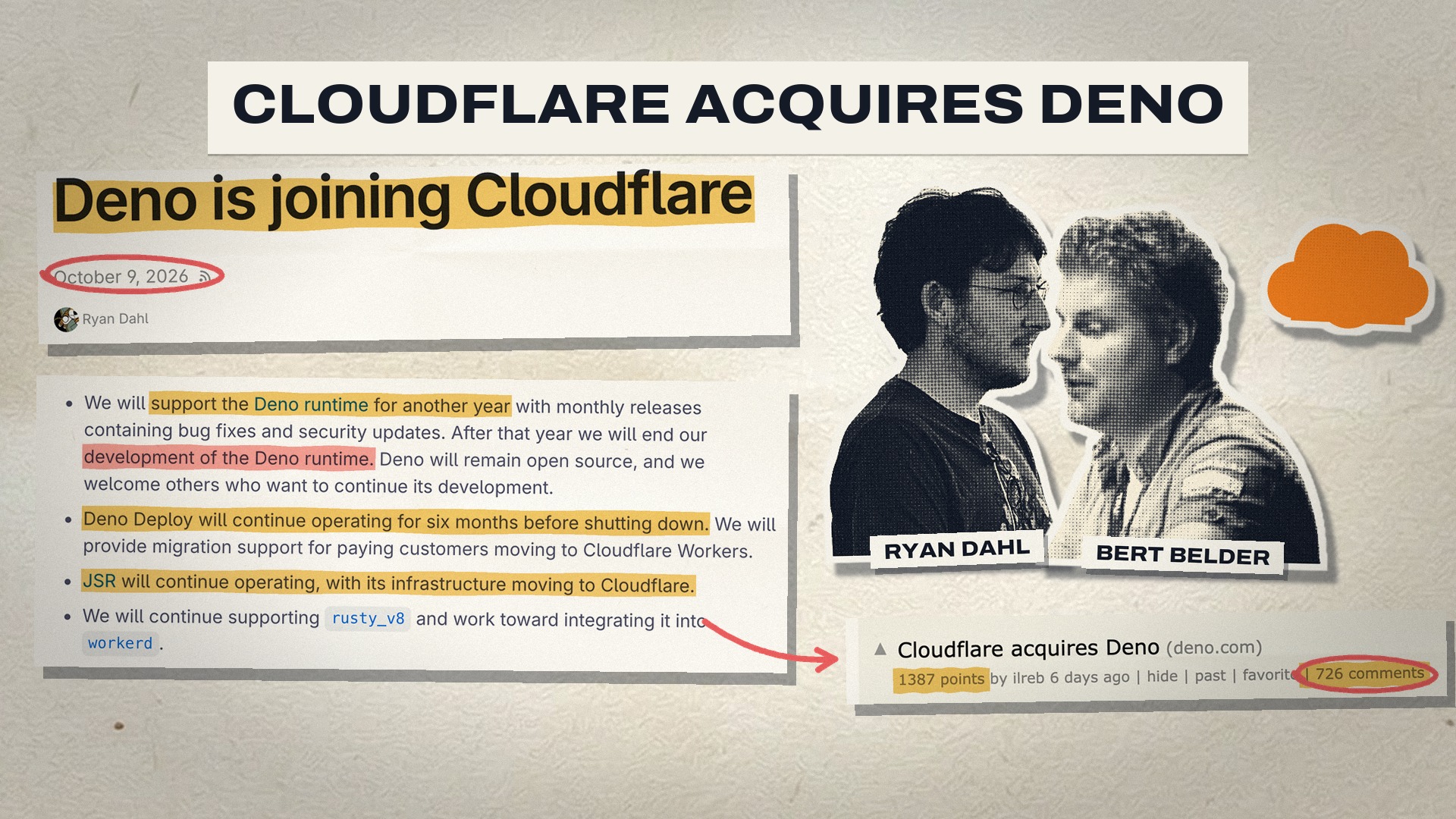
ry/rough-seaon Hacker News — creator of both Node.js and Deno), co-founder Bert Belder, and the entire Deno engineering team are joining Cloudflare to combine forces with the Cloudflare Workers and Durable Objects teams (🤝 two founders shaking hands in front of the orange Cloudflare cloud). - Cloudflare Leadership in the Trenches: Kenton Varda (
kentonv, Tech Lead of Cloudflare Workers and co-author of the joint Cloudflare announcement) jumped directly into the Hacker News thread to defend the strategy and explain the technical roadmap. - Impacted Ecosystem & Rivals: Startups and engineering teams that went all-in on the Deno runtime or Deno Deploy, alongside a rapidly consolidating JavaScript runtime landscape where Node.js stands as the lone independent foundation-backed giant after Anthropic acquired Bun and Cloudflare absorbed Deno.
📦 2. What Is Happening in the Acquisition?
Cloudflare has acqui-hired the entire Deno team, pivoting their future engineering away from maintaining a standalone JavaScript runtime and hosting service toward a shared distributed platform*(🪦 a Deno dinosaur tombstone beside the Cloudflare tower)*:
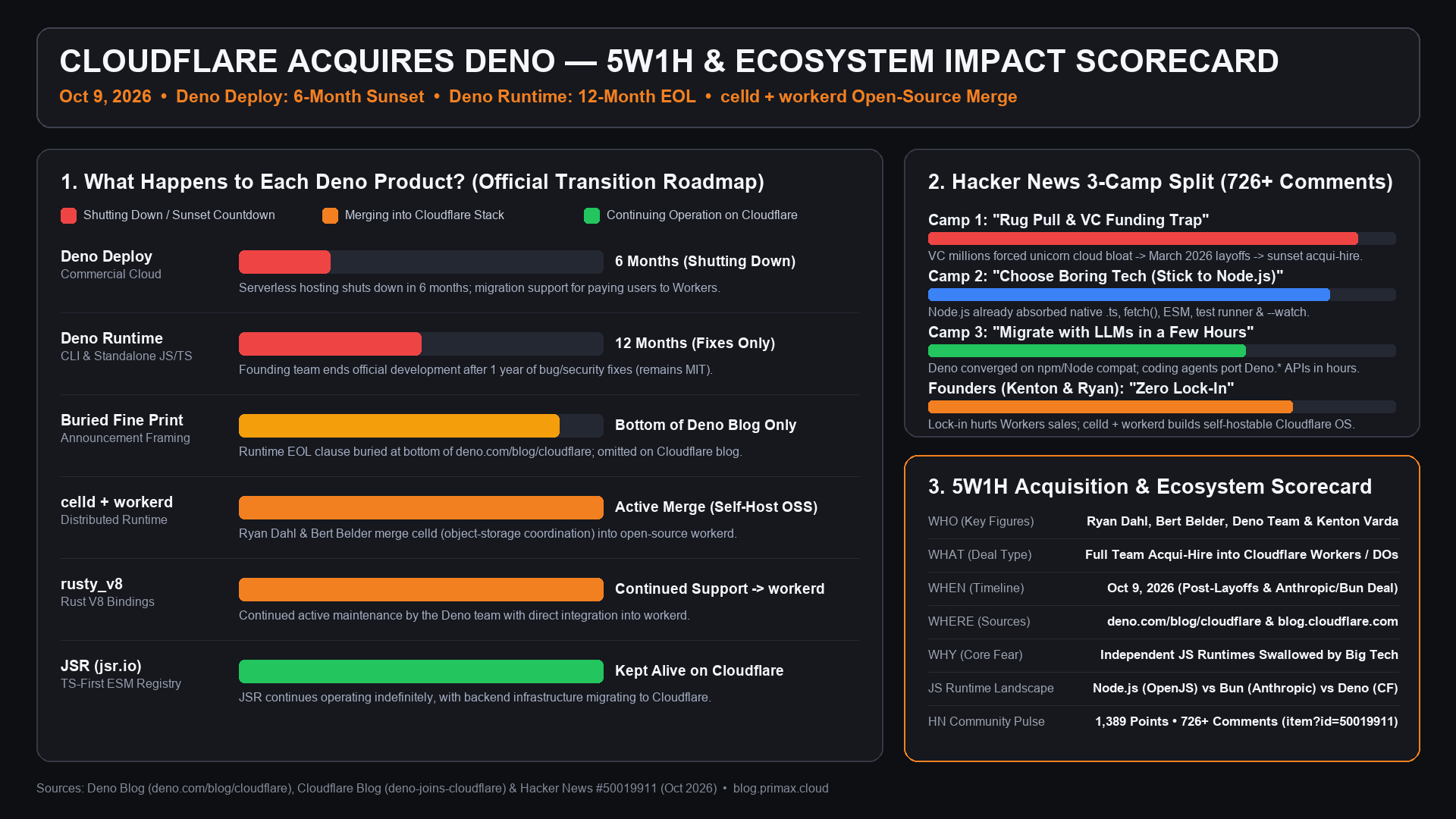
- Deno Runtime Sunset (1-Year Countdown): The team will support the Deno runtime for 12 more months with monthly bug-fix and security releases. After one year, the founding team will permanently end development of the Deno runtime (leaving the repository MIT-licensed for anyone in the community who wishes to fork or maintain it).
- Deno Deploy Shuts Down in 6 Months: Deno's commercial serverless cloud, Deno Deploy, will continue operating for 6 months before shutting down completely, with migration support provided for paying customers moving onto Cloudflare Workers.
- JSR Moves to Cloudflare Infrastructure: The TypeScript-first ESM package registry JSR (
jsr.io) will continue operating, with its backend infrastructure migrating to Cloudflare. rusty_v8&celldMerge intoworkerd: The team will continue maintainingrusty_v8and integrate it—along with their distributed object-storage runtimecelld—directly into Cloudflare's open-sourceworkerdruntime.
📅 3. When & Where?
- When: Officially announced on October 9, 2026, starting a hard 6-month hosting countdown and 12-month runtime EOL clock (📅 an October calendar counting down 12 months)—arriving just months after Deno's March 2026 layoffs and shortly after rival runtime Bun was acquired by Anthropic.
- Where: Published simultaneously on deno.com/blog/cloudflare ("Deno is joining Cloudflare") and blog.cloudflare.com/deno-joins-cloudflare ("Deno joins Cloudflare"), igniting Hacker News (#50019911) with 1,389 points and 726+ comments. Notably, the bombshell clause ending Deno runtime development was buried in a bullet list near the very bottom of Deno's blog post—and not mentioned at all in Cloudflare's blog post (🔍 a magnifying glass inspecting the fine print at the bottom of the page).
🎯 4. Why Did This Ignite Hacker News?
- Another Independent JS Runtime Evaporates: With Bun absorbed into Anthropic (and turned into a showcase for LLM-driven Zig-to-Rust rewrites) and Deno acqui-hired by Cloudflare, independent venture-backed alternatives to Node.js have effectively vanished.
- Forced Migration for "All-In" Adopters: Companies that bet their production backend on Deno or spent months migrating off Node.js now face mandatory infrastructure and runtime migrations.
- Big Tech & AI Swallowing Open-Source Tooling: Sparks deep community anxiety that foundational open-source developer tools are being systematically swallowed by Big Tech clouds and AI labs racing to build sandboxed AI agent harnesses (🐟 big fish eating small fish in the npm pond). As Ryan Dahl (
rough-sea) candidly admitted on HN, Deno got "sucked into the gravity well of Node compatibility—why reimplement Node? It works," shifting his ambition to Durable Objects and AI agent infrastructure (celld).
⚙️ 5. How Did the Community React & How Does Cloudflare Defend It?
The 726-comment Hacker News thread fractured into three distinct developer camps alongside a direct technical rebuttal from the founders (⚔️ three factions arguing around a still-warm grave):
- Camp 1 — "Rug Pull / Toxic Acqui-Hire & The VC Trap": Calls the move a textbook open-source rug pull—arguing that raising millions in VC funding forced Deno to chase unsustainable "unicorn cloud" margins instead of surviving sustainably as an open-source foundation or support-contract business, inevitably ending in layoffs and a sunset acqui-hire.
- Camp 2 — "Choose Boring Technology (Just Use Node.js)": Feels vindicated for sticking with Node.js (
pnpm+Vitest). They point out that Deno succeeded for the ecosystem even if it failed as a business: competition from Deno and Bun forced Node.js to adopt native.tssupport,fetch(), ES Modules, Web Streams/Crypto,--watch, and a built-in test runner. - Camp 3 — "Migrate with an LLM in a Few Hours": Pragmatists argue that because Deno already converged on Node/npm compatibility, migrating off
Deno.*APIs back to standard Node.js or Cloudflare Workers now takes only a few hours with coding LLMs. - Kenton Varda & Ryan Dahl's Defense (
celldworkerd): Kenton Varda (kentonv) and Ryan Dahl (rough-sea) rejected the "buy-to-kill" accusation, explaining that fear of vendor lock-in actively hurts Cloudflare Workers adoption. Ryan and Bert will lead a new open-source initiative mergingcelldintoworkerdto deliver a first-class, open-source, self-hostable runtime for Workers and Durable Objects coordinated purely over object storage—allowing developers to run the Workers programming model on their own servers.
✅ CONCLUSION
I feel sorry for Deno because it had many good ideas (permission model, native TS, all-in-one toolchain) and once pushed Node to improve, but the overall conclusion is that Node is still the safer choice, and you shouldn't bet your entire infrastructure on a VC-funded runtime.