- Published on
DeepSeek Open-Sources DeepInfer: Apache 2.0 Runtime, Missing KV-Cache & The US Ban
- Authors

- Name
- Hoang Nguyen
👤 1. Who Is Involved & Impacted?
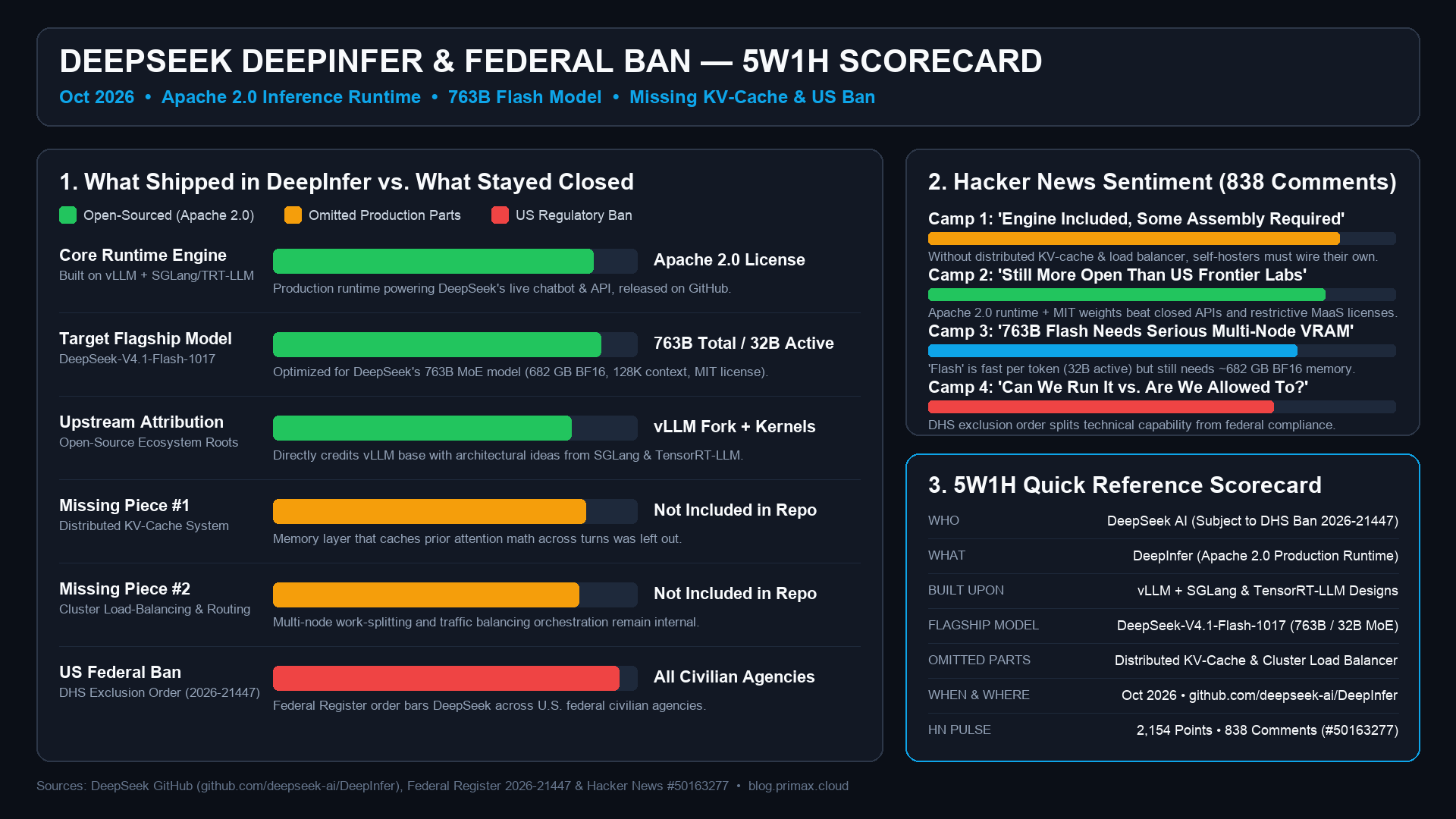
- Creator: DeepSeek AI, open-sourcing the production inference runtime behind its live chatbot and API alongside
DeepSeek-V4.1-Flash-1017(763Btotal /32Bactive MoE). - Upstream Foundations: Built on vLLM, incorporating scheduling and kernel optimizations inspired by SGLang and NVIDIA TensorRT-LLM.
- Regulators & Operators: U.S. federal civilian agencies—newly barred from DeepSeek under DHS exclusion order
2026-21447—and self-hosted GPU cluster operators worldwide.
📦 2. What Is DeepInfer (and What Was Left Out)?
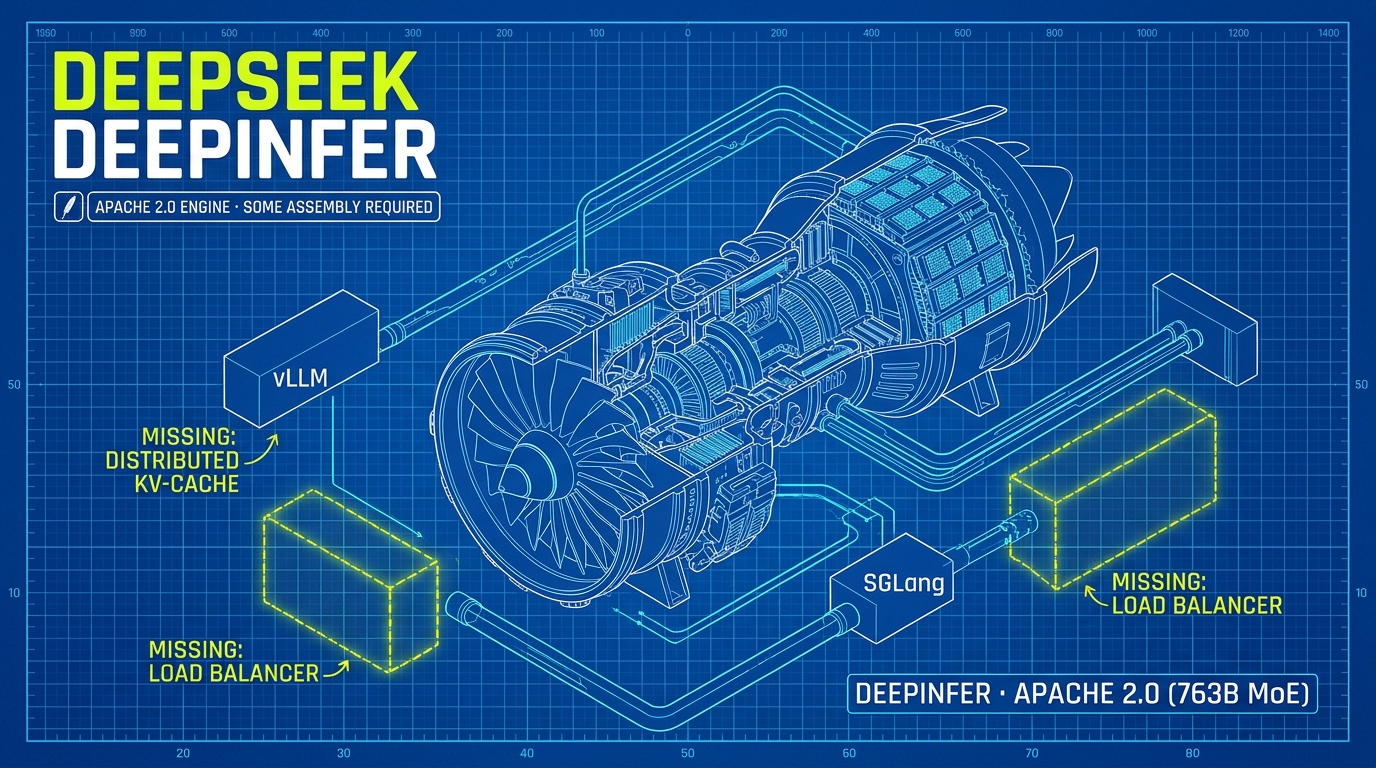
DeepInfer (deepseek-ai/DeepInfer) is DeepSeek's Apache 2.0 LLM inference engine tuned for large Mixture-of-Experts models like DeepSeek-V4.1-Flash-1017:
- Apache 2.0 Production Runtime: Releases the core execution engine, custom MoE kernels, and token generation pipeline powering DeepSeek's live production service.
vLLM+SGLang/TensorRT-LLMArchitecture: Extends vLLM while openly crediting SGLang and TensorRT-LLM for key runtime techniques.- Omitted #1 — Distributed KV-Cache Storage: Excludes DeepSeek's internal KV-cache storage layer that caches and reuses prior conversation attention states across turns.
- Omitted #2 — Cluster Load-Balancing & Work-Splitting: Excludes the multi-node router and prefill/decode scheduler that balance traffic across GPU server clusters ("Engine included. Some assembly required.").
📅 3. When & Where?
- When: Released in mid-October 2026 alongside
DeepSeek-V4.1-Flash-1017and the U.S. DHS federal exclusion order. - Where: Published on GitHub (
deepseek-ai/DeepInfer) and Hugging Face (DeepSeek-V4.1-Flash-1017), reaching 2,154 points and 838 comments on Hacker News #50163277.
🎯 4. Why Did DeepInfer Dominate Hacker News?
- Missing the Multi-Node Secret Sauce: At 763B parameters (
~682 GBin BF16), the omitted distributed KV-cache and cross-node load balancer are the exact components required to serve multi-node MoE clusters cheaply at scale. - Upstream Reciprocity: Unlike closed frontier labs, publishing under Apache 2.0 lets vLLM and SGLang maintainers port DeepSeek's custom MoE kernels directly back into upstream open-source runtimes.
- Technical Openness vs. Geopolitical Ban: The simultaneous DHS exclusion order split enterprise reactions between "Can our GPUs run it?" and "Is our compliance team allowed to touch it?"
⚙️ 5. Stack Breakdown & Community Reaction
| Component | Status in DeepInfer | License / Spec | Operational Reality |
|---|---|---|---|
| Core MoE Runtime & Kernels | Included | Apache 2.0 (built on vLLM) | Ready for single-node / upstream porting |
Target Model (V4.1-Flash-1017) | Included | 763B total / 32B active (MIT) | Needs ~682 GB VRAM (BF16) across nodes |
| Distributed KV-Cache Store | Omitted | Proprietary internal fabric | Self-hosters must supply their own KV cache |
| Cluster Load Balancer / Router | Omitted | Proprietary orchestration | Requires external prefill/decode routing |
- 763B Is Called "Flash"?: Engineers joked that calling a 763-billion-parameter model "Flash" redefines the word—even with only
32Bactive per token, keeping all 763B weights in memory demands a multi-node GPU cluster. - Why the Router Stayed Closed: Systems engineers noted that DeepSeek's KV-cache and cluster scheduler are tightly coupled to its internal RDMA/storage fabric and represent its core unit-cost moat.
- True Open Source vs. Revenue Caps: Commenters contrasted DeepSeek's Apache 2.0 + MIT releases against US open-weight releases that attach
$20Mcommercial revenue restrictions.
✅ CONCLUSION
DeepSeek's Apache 2.0 release of DeepInfer is a major contribution to the vLLM and SGLang ecosystem, even if self-hosters still have to bring their own distributed KV-cache, cluster load balancer, and 700 GB of VRAM—assuming their compliance team lets them run it.