- Published on
Claude Reveals NIST ECDSA Curve Origins: Unix Time and lrand48()
- Authors

- Name
- Hoang Nguyen
👤 1. Who Is Involved & Impacted?
- Discoverer & Verifier: Anthropic Research (Nicholas Carlini using an internal research snapshot of Claude) and Filippo Valsorda (
@FiloSottile), creator of the $36,864 NIST Elliptic Curves Seeds Bounty (donated to Let's Encrypt / ISRG). - Original Curve Authors: NSA mathematician Jerry Solinas and NIST, who standardized the five prime curves (
P-192,P-224,P-256,P-384,P-521) in ANSI X9.62 and FIPS 186-2 (2000). - Impacted Ecosystem: Virtually every TLS handshake, SSH key, JWT, and signed update relying on ECDSA P-256 / P-384.
📦 2. What Did Claude Discover?
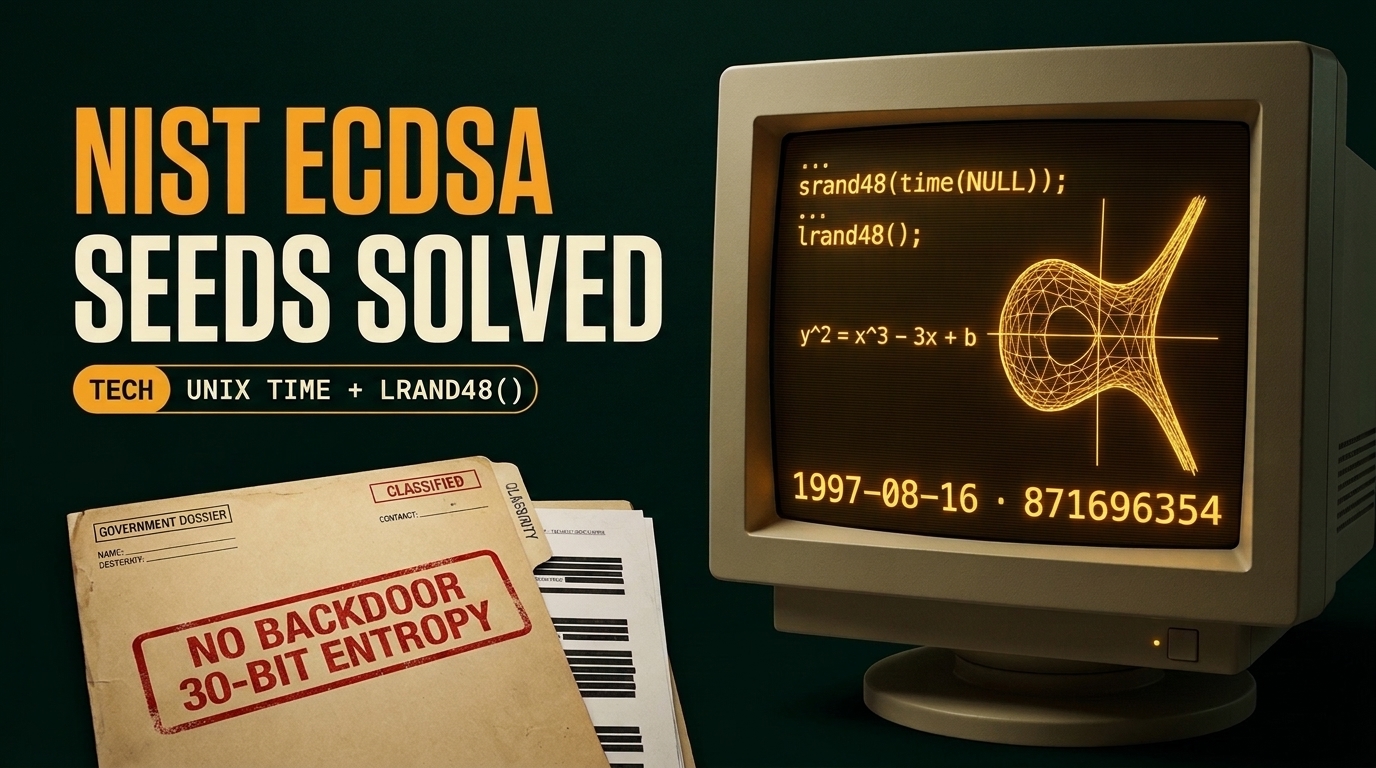
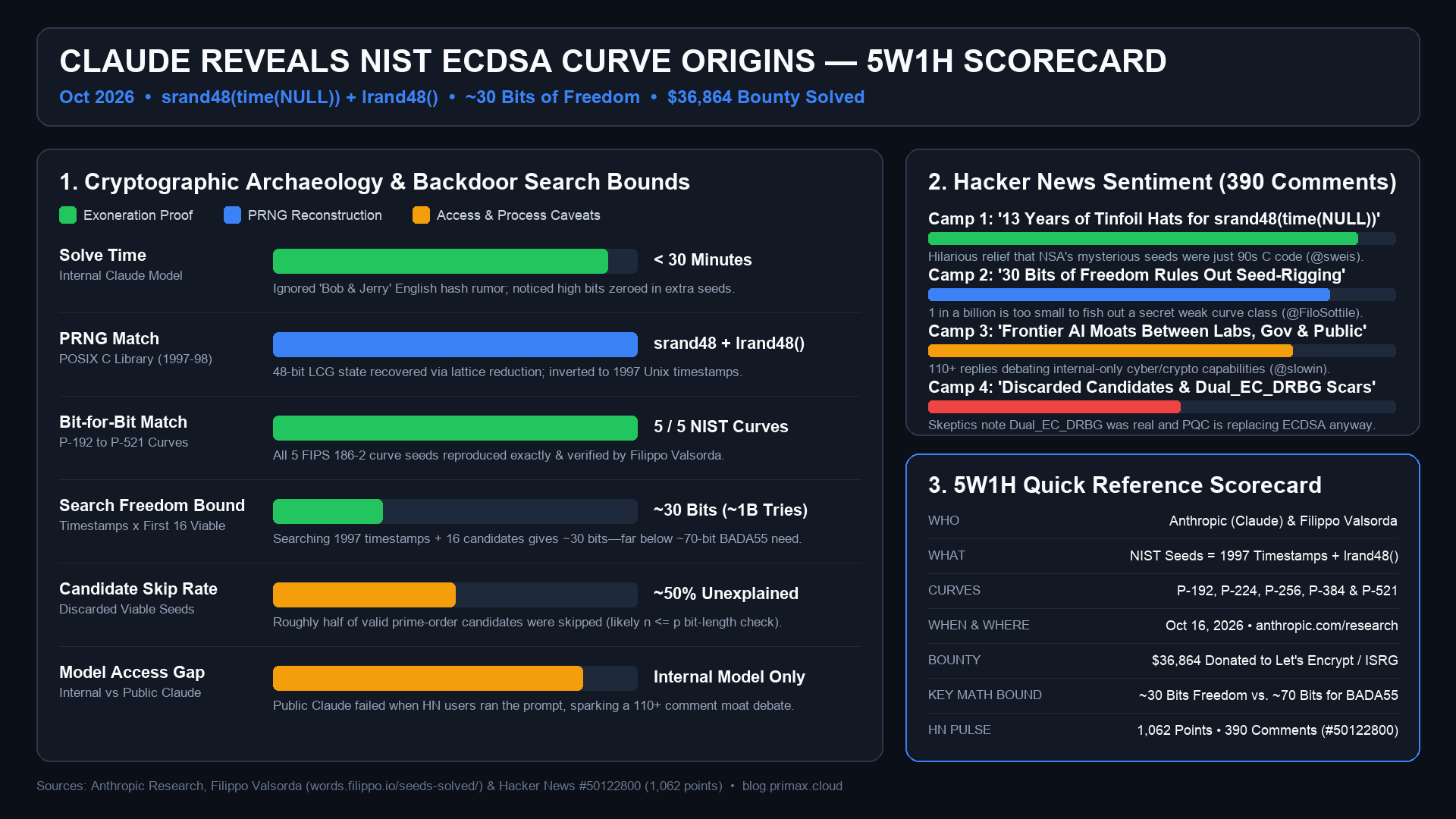
For 25 years, lore from Koblitz & Menezes (2015) held that the five 160-bit (20-byte) NIST hex seeds were SHA-1 hashes of a forgotten English phrase ("Give Bob and Jerry a raise"). Claude solved the actual derivation in under 30 minutes:
- The High-Bit Anomaly: Ignoring the English passphrase rumor, Claude inspected auxiliary X9.62 seeds and spotted that the most significant bit of every 32-bit word was always
0. - The
lrand48()Fingerprint: That 31-bit non-negative output pattern matchedlrand48()/drand48(), the 1990s POSIX C standard library linear congruential generator (LCG) with a 48-bit internal state. - Lattice Reduction (
LLL) to 1997 Unix Time: Using lattice basis reduction, Claude reconstructed the full 48-bit state across five consecutive 32-bit outputs and stepped the generator backward tosrand48(time(NULL))—landing on autumn 1997 Unix timestamps (e.g.,P-256at871696354=1997-08-16 01:52:34 UTC). - Self-Doubt in the Trace: The solution was so simple that Claude paused in its reasoning trace to ask: "Wait... am I in some sort of simulated/test environment?"
📅 3. When & Where?
- When: Published on October 16, 2026, closing a mystery dating back to August–October 1997.
- Where: Detailed on Anthropic Research, verified by Filippo Valsorda, and discussed on Hacker News #50122800 (1,062 points, 390 comments).
🎯 4. Why Does This Deflate the NSA Seed-Rigging Theory?
- At Most ~30 Bits of Freedom (
~10^9Curves): Even if the NSA tested every second of 1997 and picked among the first 16 viable candidates (accounting for an ~50% skip rate, likely an order check ), Filippo Valsorda showed this leaves barely ~30 bits of selection freedom. - Too Small to Hide a Backdoor: As shown in Bernstein & Lange's
BADA55paper, grinding for a secret mathematical weakness requires to trials—unless 1 in every billion prime curves belonged to an undiscovered weak class that academic cryptographers missed for 30 years.
⚙️ 5. Technical Summary & Community Reaction
| Component / Question | Old Lore (1997–2026) | Actual Mechanism (Solved) | Security Implication |
|---|---|---|---|
| Seed Source | Hashed English phrase | srand48(time(NULL)) + lrand48() | Standard 1990s Solaris/POSIX C code |
| P-256 Seed Origin | Unknown 160-bit hex | Unix timestamp 871696354 (1997-08-16) | Reproducible via 48-bit LCG step |
| Search Space | Unbounded text brute-force | ~2^30 (~1 billion candidates) | Far below 2^61+ needed for rigging |
| Solver Cost | 25 years unsolved | <30 minutes (Claude + LLL) | $36,864 bounty donated to ISRG |
- 13 Years of Tinfoil Hats (
@sweis,@tptacek): Security researcher Steve Weis (@sweis), who originally investigated the passphrase rumor, summed up the saga: "13 years of tinfoil hats forsrand48(time(NULL)." - Internal vs. Public Model Moat (
@slowin— 110+ replies): Public Claude failed when given the exact same prompt, sparking debate over the growing capability gap between internal lab checkpoints and public releases. - Cleared Right Before Retirement: Commenters noted the irony that NIST P-curves were finally exonerated just as the industry begins migrating toward post-quantum signatures (ML-DSA).
✅ CONCLUSION
A quarter-century of NSA backdoor suspicion over the NIST P-curve seeds boiled down to a 1990s programmer calling srand48(time(NULL)), leaving at most ~30 bits of selection freedom and proving how frontier AI plus lattice math can crack cold-case cryptographic mysteries in minutes.