- Published on
Mistral Large 4
- Authors

- Name
- Hoang Nguyen
👤 1. Who Is Involved & Impacted?
- Core Development Team: Built from scratch by Mistral AI (Europe's flagship AI lab, newly backed by a record €3 billion Series D—the largest equity round ever raised by a European tech company), trained on 3,800 NVIDIA Grace Blackwell GPUs inside Mistral's own European data centers.
- Direct Competitors: Leading open-weight frontier models—primarily top Chinese labs including DeepSeek V4 Pro (
0813), Zhipu GLM-5.3 / 5.2, Moonshot Kimi K3 / K2.6, Alibaba Qwen 3.8 Max, and MiMo-V2.6-Pro—alongside closed proprietary giants (Claude Opus 5 / 5.5, OpenAI GPT-6 Astra / GPT-6.1 Sol). - Target Users: Cybersecurity & Red-Teaming Engineers (frequently blocked by safety refusals on closed models), Enterprise Teams in Finance, Law, Manufacturing, and Public Sector requiring EU AI Sovereignty / On-Premise Deployment, and AI Agent Developers.
📦 2. What Is New in Mistral Large 4?
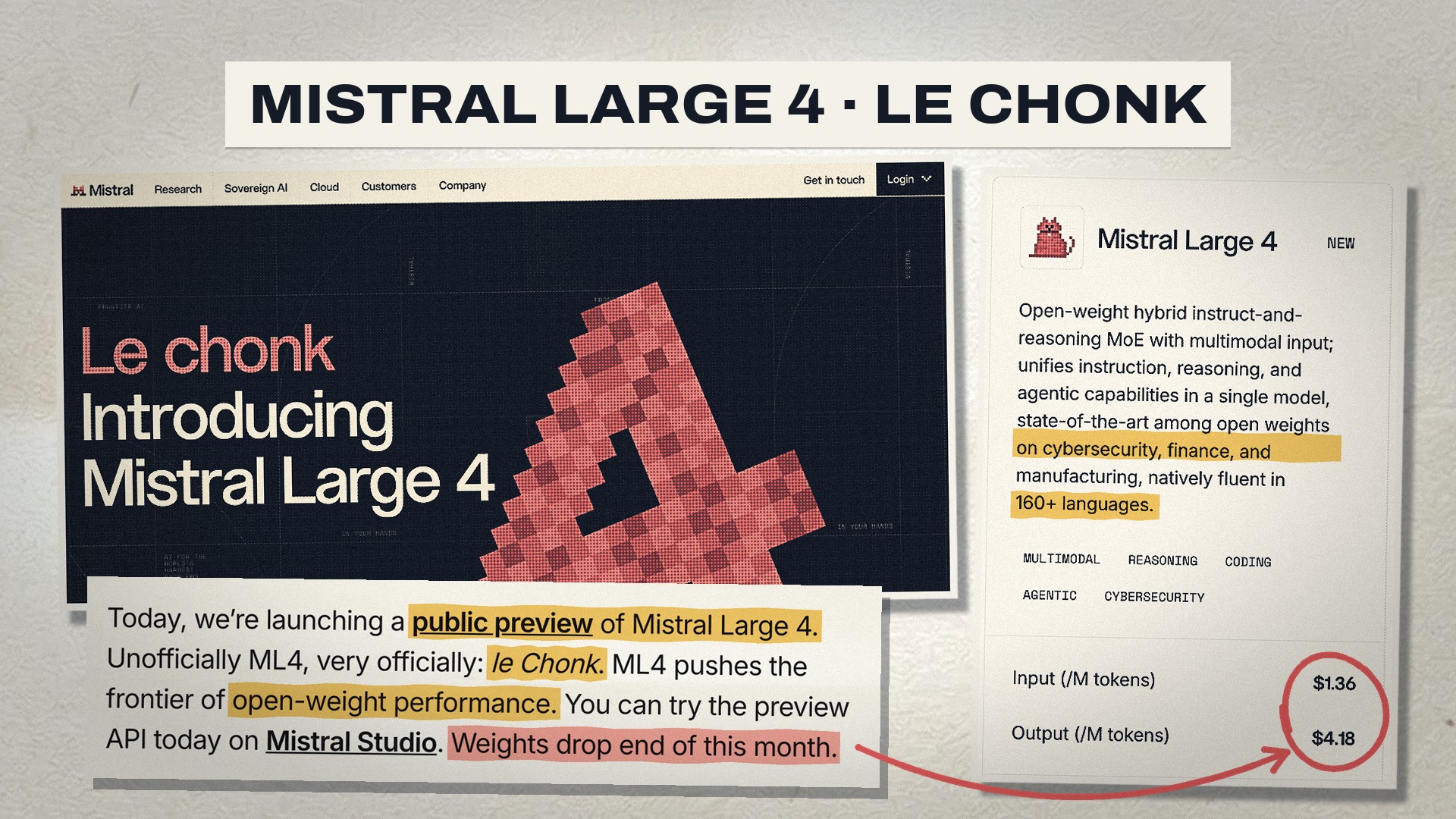
Mistral Large 4 (unofficially ML4, officially nicknamed "le Chonk") is a flagship open-weight multimodal model centered around 5 core changes:
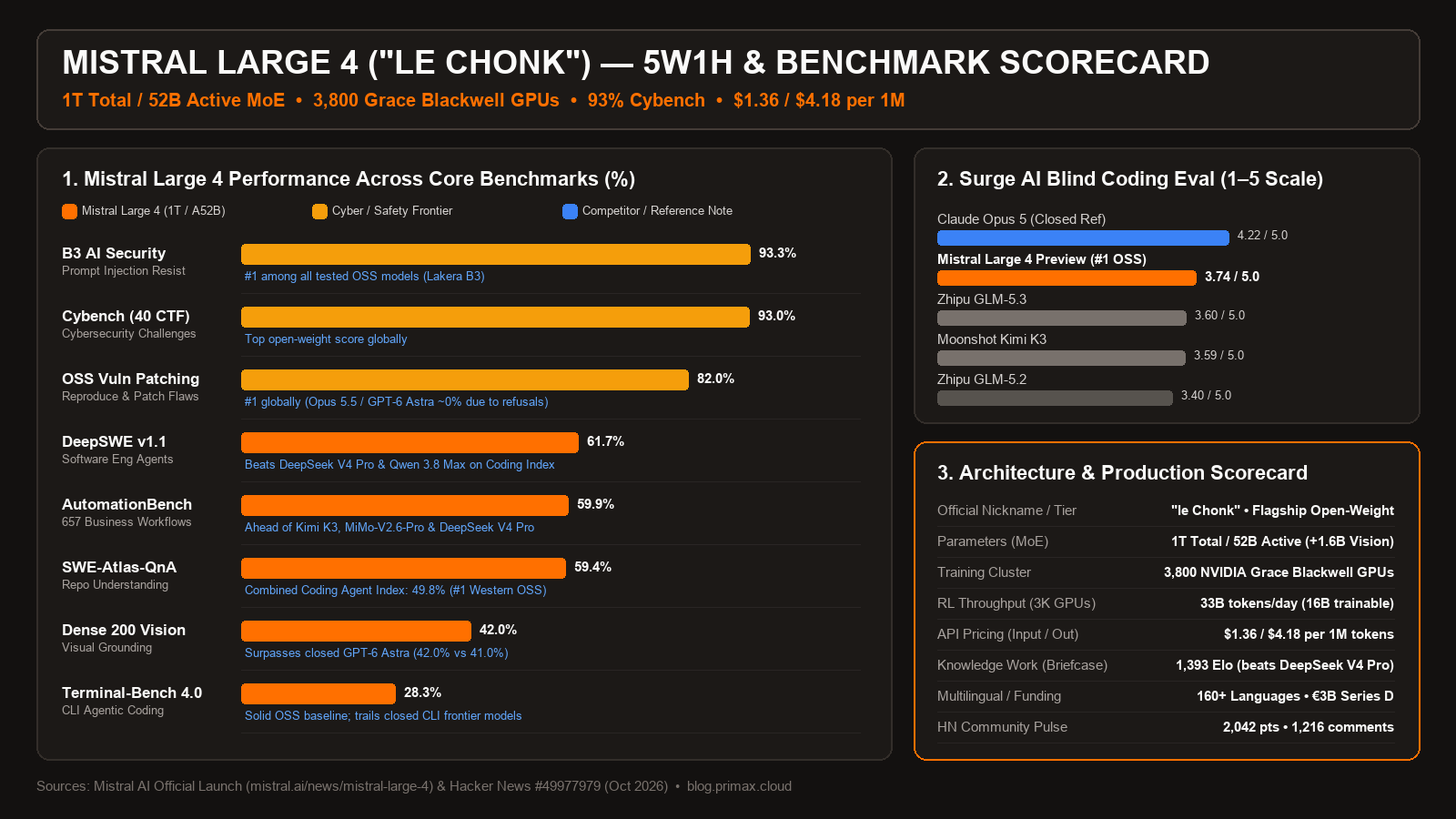
- 1-Trillion Parameter Sparse MoE Architecture: Features 1T total parameters with 52B active parameters per token (paired with a 1.6B vision encoder) and up to a 1M-token context window, priced competitively at
$1.36/$4.18per 1M input/output tokens via API. - Unified Hybrid Instruct, Reasoning & Agentic Engine: Combines fast instruction following, configurable thinking effort (
reasoning_effort), and long-horizon agentic tool use (AutomationBench: 59.9%across 657 multi-step workflows;AA-Briefcase: 1,393 Elo, ahead of DeepSeek V4 Pro) within a single model. - State-of-the-Art Defensive Cybersecurity & Safety: Ranks top-5 globally on the Artificial Analysis Cyber Index, solves 93% of Cybench (40 CTF challenges), and scores 82% (#1 of any model globally) on reproducing and patching real-world open-source vulnerabilities—while resisting 93.3% of indirect prompt-injection attacks on Lakera's B3 AI Security Benchmark and earning 1.691/2.0 ("Exemplary") on KORABench.
- Step-Change Multimodal Grounding & STEM/CAD: Inspects gigapixel satellite imagery, mechanical/CAD blueprints, and complex financial PDFs—surpassing GPT-6 Astra on Dense 200 (
42%vs.41%), leading open-weight models on SciCode-Verified (one-shot Hartree–Fock quantum chemistry simulations), and beating GPT-6 Astra on third-party vals.ai Legal & Finance evaluations and Harvey AI's Legal Agent Benchmark. - Large-Scale Asynchronous RL & 160+ Languages: Post-trained with an autoscaling reinforcement learning pipeline generating 33 billion tokens per day (16B trainable completion tokens across 3,000 GPUs) and natively fluent in 160+ languages (including every official EU language).
📅 3. When & Where?
- When: Public preview launched on October 6, 2026, with open-weight checkpoints scheduled for public release by the end of October 2026 as the large-scale RL training run completes.
- Where: Available today in preview on Mistral Studio, Mistral Forge, and OpenRouter—hosted end-to-end on European infrastructure under EU law—sparking a massive debate on Hacker News with 2,042 points and 1,216 comments.
🎯 4. Why Launch Mistral Large 4?
- Eliminating Closed-Model Cybersecurity Refusals: Closed frontier models like Claude Opus 5.5 and GPT-6 Astra score near 0% on real vulnerability reproduction and patching benchmarks because provider-level guardrails refuse defensive security prompts—leaving blue teams hamstrung mid-incident while attackers jailbreak models anyway.
- True AI Sovereignty & Self-Deployment: Gives regulated enterprises, defense organizations, and governments an open-weight frontier model they can audit, fine-tune, and deploy on private clouds or air-gapped on-premise clusters without US/Chinese cloud lock-in.
- Reclaiming Western Open-Weight Leadership: Closes the gap with top Chinese open-weight labs, outperforming DeepSeek V4 Pro 0813 and Qwen 3.8 Max on the combined Coding Agent Index (
49.8%).
⚙️ 5. How Did They Prove It & Community Reaction?
- Benchmark Methodology: Evaluated across independent third-party suites (Artificial Analysis, vals.ai, Harvey AI, Lakera B3) and blind human evaluations (Surge AI 1–5 coding scale plus domain-expert panels in STEM, CAD, and Finance).
- Real-World Results & Bottlenecks:
- Wins: Scored 61.7% on DeepSWE v1.1, 59.4% on SWE-Atlas-QnA, 82% on OSS Vulnerability Patching (#1 globally), 93% on Cybench, and ranked 2nd overall (#1 among all open-weight models) on Surge AI's blind human coding evaluation (
3.74 / 5.0), beating GLM-5.3 (3.60), Kimi K3 (3.59), and GLM-5.2 (3.40), trailing only closed Claude Opus 5 (4.22). - Admitted Bottlenecks: Scores 28.3% on Terminal-Bench 4.0 (trailing closed CLI agent leaders), and its 1T total parameter footprint requires multi-GPU enterprise hardware rather than local consumer workstations.
- Wins: Scored 61.7% on DeepSWE v1.1, 59.4% on SWE-Atlas-QnA, 82% on OSS Vulnerability Patching (#1 globally), 93% on Cybench, and ranked 2nd overall (#1 among all open-weight models) on Surge AI's blind human coding evaluation (
- Multi-Angle Perspectives from Hacker News:
- On API & Reasoning Quirks: Simon Willison (
simonw) tested his signature Pelican-on-a-Bicycle SVG benchmark and noted thatreasoning_effortcurrently only accepts"none"or"high"(with"high"producing a much cleaner illustration while curiously reporting fewer output tokens). Other testers flagged early preview rough edges where internal reasoning traces leaked into responses or stumbled onjqtool calls. - On "Open Weights vs. Open Science" & Hardware Reality: While the community celebrated the playful "le Chonk" ("Le chaton fat") nickname and cheered Europe's return to the frontier race, researchers criticized the growing "open-weight but closed-science" trend (releasing weights without publishing architectural training papers like Chinese labs do), and self-hosters pointed out that mid-sized models like
Qwen 3.8(27B–120B) remain far more practical for local hardware than a 1T MoE giant.
- On API & Reasoning Quirks: Simon Willison (
✅ CONCLUSION
ML4 is a welcome step forward for European AI sovereignty and the cyber sector, but in terms of benchmarks and price, it still lags behind Chinese open-weights and is far from the US frontier — used because it's 'made in EU' rather than because it's the best.