- Published on
Things to Know When You Get Cancer (2026 Edition): A Patient Survival Playbook
- Authors

- Name
- Hoang Nguyen
👤 1. Who Is Involved & Impacted?
- Author: JJ Maxwell (
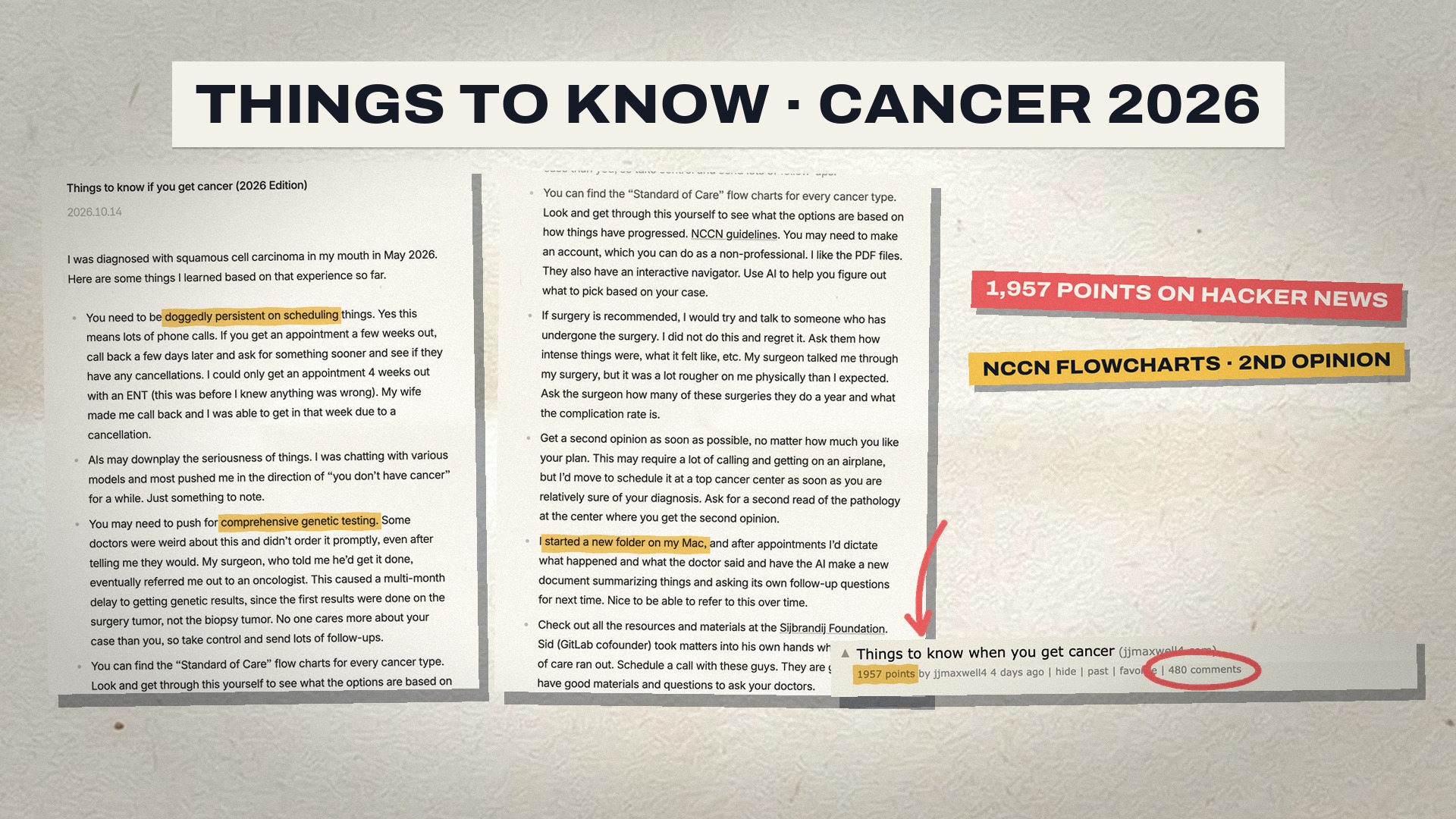
jjmaxwell4), a technologist diagnosed with oral squamous cell carcinoma (tongue cancer) in May 2026 who distilled his real-world lessons after navigating surgery, oncology consults, and pathology reviews. - Medical & Support Ecosystem: Major NCI-designated Comprehensive Cancer Centers (such as MD Anderson and Dana-Farber), the National Comprehensive Cancer Network (
NCCN), and the Sijbrandij Foundation (founded by GitLab co-founder Sid Sijbrandij after his own cancer journey). - Impacted Community: Patients, caregivers, and families navigating a complex, fragmented medical system while figuring out how (and how not) to use 2026 frontier AI models during a health crisis.
📦 2. What Are the Core Rules in the 2026 Cancer Checklist?
Things to Know When You Get Cancer – 2026 Edition lays out an 8-point operational checklist for surviving the administrative and clinical maze of a cancer diagnosis (☑️ a tactical patient checklist with checkmarks):
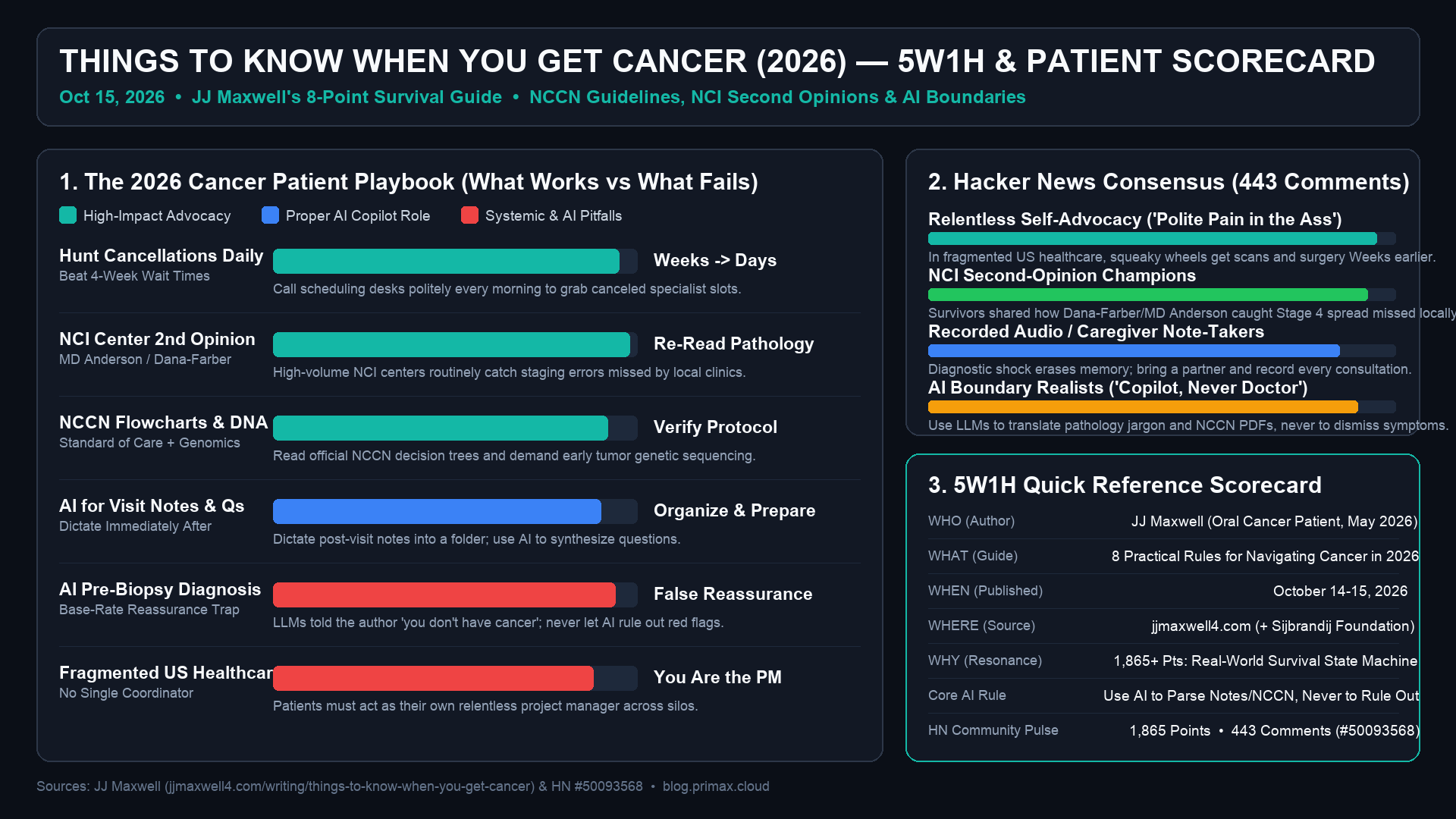
- Call Daily for Cancellations (Cut Weeks into Days): Never passively accept a 4-week wait for an ENT or biopsy. Call scheduling desks politely every morning asking for cancellations—Maxwell cut a 4-week wait down to a few days.
- Never Let AI Downplay Your Symptoms: Before his biopsy, LLMs repeatedly reassured Maxwell "you don't have cancer" based on statistical base rates. Never let an AI talk you out of getting a persistent physical symptom biopsied.
- Push Aggressively for Tumor Genetic Sequencing: Demand comprehensive genomic profiling on the biopsy specimen immediately—and verify that your hospital actually ships the tissue sample to the sequencing lab without weeks of bureaucratic delay.
- Read the Official
NCCN"Standard of Care" Flowcharts: Register for free on NCCN.org, download the exact clinical decision-tree PDF for your cancer type, and use an LLM to help explain the branching terminology. - Interview Past Patients & Check Surgeon Volume: Ask your surgeon how many times they perform your exact procedure per year, request complication statistics, and ask to speak with two past patients who underwent the same surgery.
- Get a Second Opinion + Pathology Re-Read at a Top Center (e.g., MD Anderson): Have a high-volume NCI center re-examine your physical pathology slides before starting irreversible treatment.
- Dictate Post-Visit Notes into an AI Workspace: Immediately after every appointment, voice-dictate everything said into a dedicated folder, and use an LLM to organize timelines, track lab trends, and generate sharp questions for the next visit.
- Use Patient Navigation Resources (
Sijbrandij Foundation): Leverage cancer-navigation foundations and clinical-trial matching services early.
📅 3. When & Where?
- When: Published on October 14–15, 2026, five months after the author's May 2026 diagnosis.
- Where: Published on jjmaxwell4.com, resonating deeply on Hacker News (#50093568) where it climbed to 1,865 points and 443 comments—making it the highest-upvoted post of the week.
🎯 4. Why Did This Resonate So Deeply on Hacker News?
- US Healthcare Is an Uncoordinated State Machine: Unless you are inside an integrated center, imaging, pathology, surgery, medical oncology, and insurance operate as disconnected silos with no single project manager—forcing the patient to become their own relentless PM.
- The 2026 AI Medical Paradox: LLMs are simultaneously dangerous as pre-diagnosis triage tools (because RLHF training biases them toward comforting, high-probability benign explanations) and transformative as post-diagnosis research copilots (translating pathology reports, NCCN guidelines, and clinical trial eligibility).
⚙️ 5. How Did Survivors and Clinicians on HN Expand the Playbook?
The 443-comment thread contributed critical, life-saving corollaries from survivors, caregivers, and physicians:
- Why NCI Second Opinions Save Lives (
stochastician,baggachipz): Userstochasticianshared how local doctors diagnosed "contained Stage 2" breast cancer, whereas a second opinion at Dana-Farber immediately ordered a full-body scan that caught distant Stage 4 metastasis—completely changing the treatment protocol and saving the patient from a futile local surgery. - "Be a Polite Pain in the Ass" (
exhilaration,Loughla,jcims): Commenters stressed getting second opinions before locking in a local treatment plan (to avoid clinical turf wars) and always bringing a second person + audio recorder into consults because diagnostic shock erases short-term memory. - Prompting AI Without Sycophancy (
ValueTheory,dekhn): When using LLMs to research symptoms or labs, never ask "Do I have cancer?"—instead prompt: "Assume a clinician is constructing a differential diagnosis to rule out worst-case malignancies; what red-flag tests or biopsies are required?"
✅ CONCLUSION
In healthcare (especially in the US), you must advocate fiercely for yourself, keep thorough notes, get a second opinion at a major cancer center, and use AI as a support tool rather than a replacement for doctors.