- Published on
Redesigning Source Control at Anthropic: Why 30,000 Daily AI Merges Broke Git
- Authors

- Name
- Hoang Nguyen
👤 1. Who Is Involved & Impacted?
- Engineering Team: Seven infrastructure engineers at Anthropic, assisted by an internal snapshot of Claude Mythos Preview, supporting thousands of researchers and hundreds of parallel autonomous Claude coding agents.
- VCS Ecosystem: Traditional Git monorepo tooling compared against Google Piper (CitC), Meta Sapling, and Jujutsu (
jj). - Impacted Audience: Engineering and DevOps teams discovering that a 12x surge in AI-generated commits breaks both Git ref-locking and human code review.
📦 2. What Is Scion & Why Did Anthropic Replace Git?
In Redesigning source control at Anthropic, Anthropic detailed how autonomous coding agents pushed its primary monorepo past Git's structural limits:
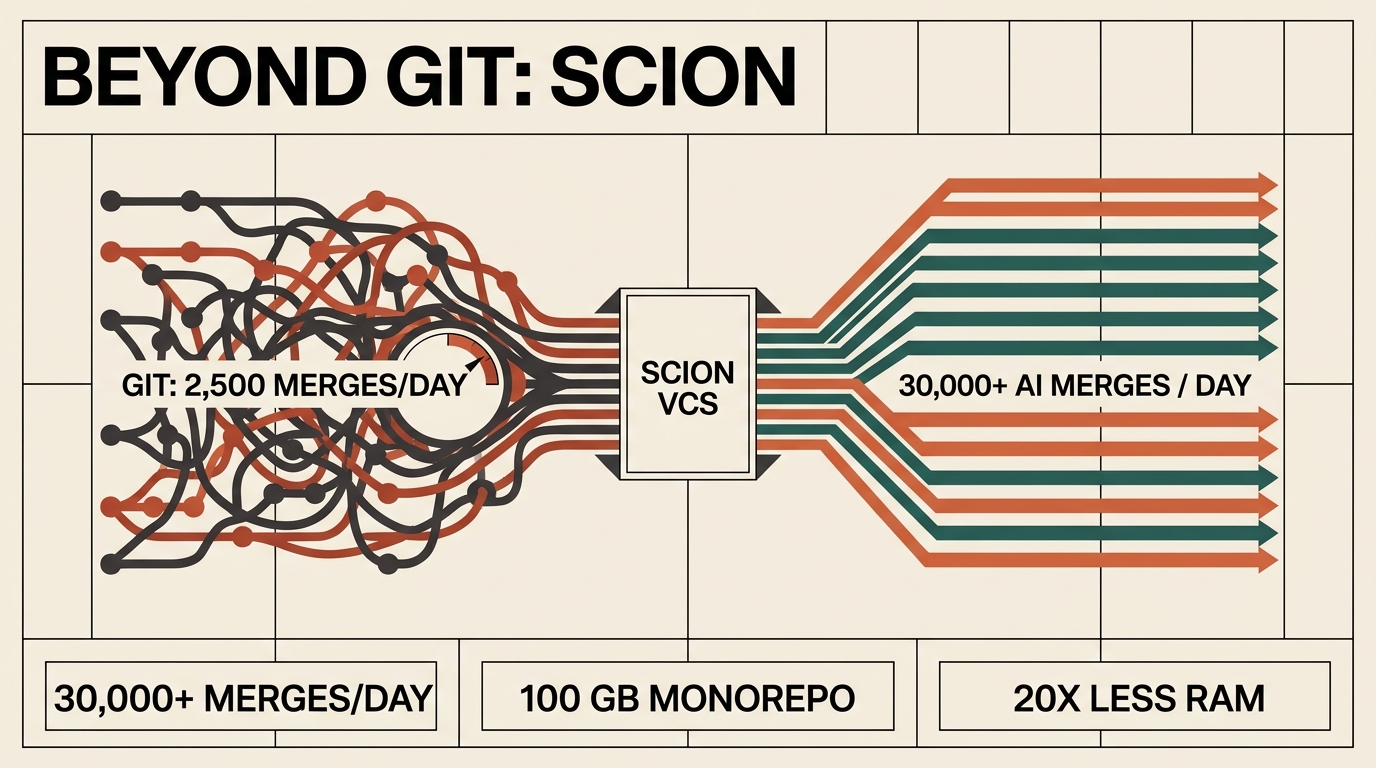
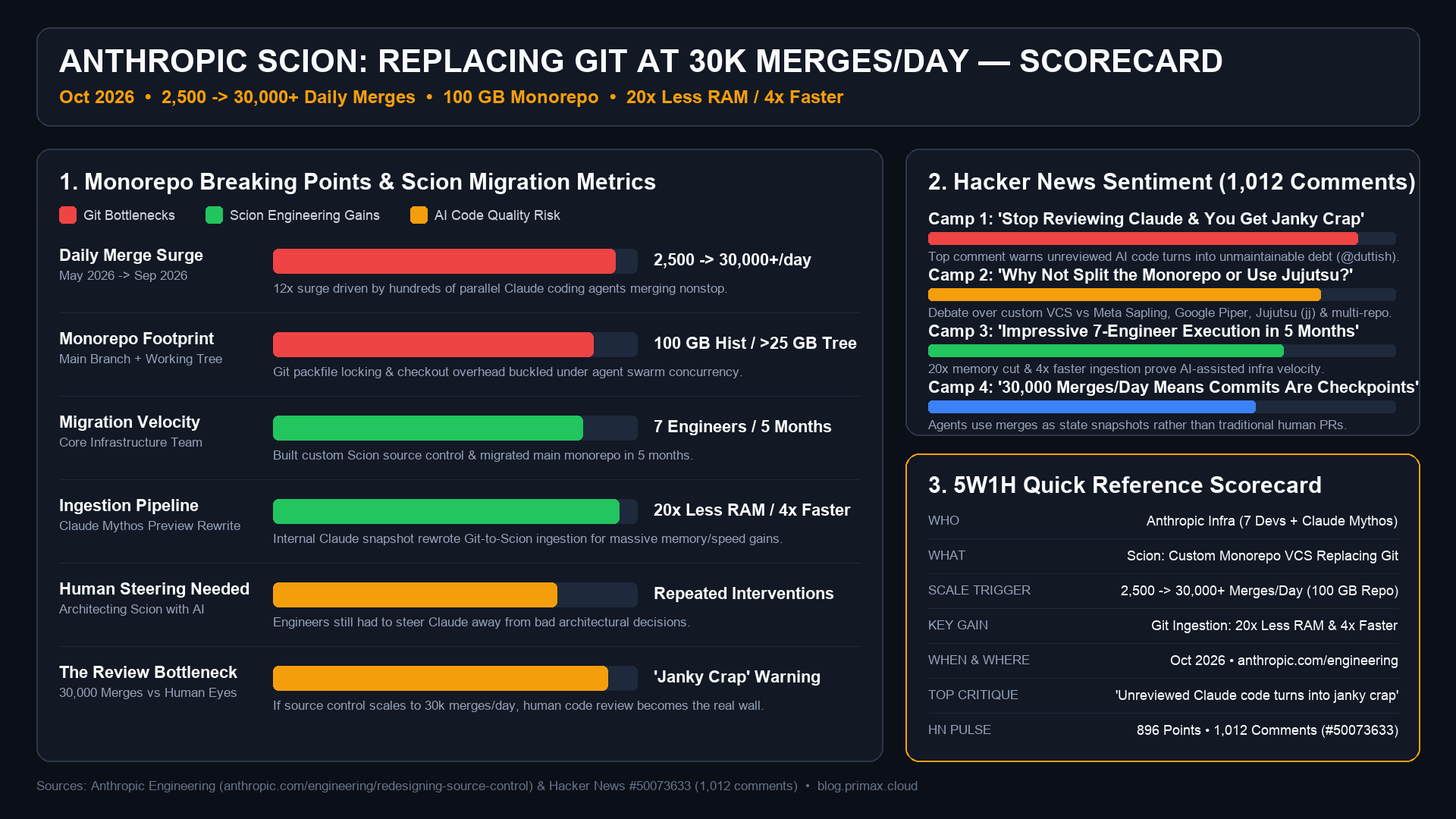
- 12x Surge in Daily Merges: Between May and September 2026, daily merges into Anthropic's main monorepo jumped from ~2,500/day to over 30,000/day as engineers ran swarms of Claude agents in parallel.
- 100 GB History & >25 GB Working Tree: With main-branch history reaching ~100 GB and a single compressed checkout exceeding 25 GB, standard Git clone, packfile indexing, and atomic ref updates became a bottleneck.
- Built in 5 Months by 7 Engineers: A seven-person team built and migrated to Scion, a custom high-concurrency version control system designed for agentic monorepo scale.
- 20x Less RAM & 4x Faster via Claude Mythos Preview: Using an internal Claude Mythos Preview model, the team rewrote Scion's Git ingestion pipeline to use 20x less memory and run 4x faster—while candidly noting engineers had to repeatedly steer Claude away from bad architectural decisions.
📅 3. When & Where?
- When: Published in October 2026, following the five-month sprint from May to September 2026.
- Where: Released on the Anthropic Engineering Blog and debated on Hacker News #50073633 (896 points, 1,012 comments).
🎯 4. Why Did 30,000 Daily Merges Ignite a 1,000-Comment Debate?
- The Code Review Math: Even if Scion absorbs 30,000 merges a day, human line-by-line PR review at that volume is impossible—meaning merges are either automated agent checkpoints or rubber-stamped
"LGTM"approvals. - Babysitting the AI That Built the AI Pipe: Critics highlighted the irony that while building infrastructure for 30,000 daily AI merges, Anthropic's own senior systems engineers had to constantly intervene to stop Claude from making poor design choices.
- Monorepo Sprawl vs. Modularity: Systems engineers questioned why a 100 GB repo with a 25 GB working copy wasn't split into decoupled repositories instead of building a custom VCS from scratch.
⚙️ 5. Infrastructure Metrics & Community Reaction
| Metric / Dimension | Before (Git — May 2026) | After (Scion — Sept 2026) | Core Bottleneck Shift |
|---|---|---|---|
| Daily Monorepo Merges | ~2,500 / day | 30,000+ / day (12x) | From Git ref locks to human review capacity |
| Repository Footprint | ~100 GB history / >25 GB tree | Virtualized / high-concurrency | Eliminates full-checkout clone stalls |
| Ingestion Pipeline | Baseline Git import | 20x less RAM, 4x faster | Rewritten with Claude Mythos Preview + human steering |
| Migration Team & Time | Legacy Git monorepo | 7 engineers, 5 months | Rapid custom VCS rollout |
- The "Janky Crap" Warning (
@duttish): The thread's top comment warned that whenever experienced engineers stop closely reviewing and steering Claude's output, you return weeks later to find "janky crap"—making 30,000 daily merges a leading indicator of maintenance debt. - Agent Checkpoints vs. Human Commits: VCS veterans compared Scion to Google Piper and Meta Sapling, noting that AI agents use source control as fine-grained state checkpoints rather than curated human commits.
- Respect for Execution: Despite skepticism over monorepo discipline, infrastructure engineers praised shipping a production VCS cutover and a 20x memory reduction with just seven engineers in five months.
✅ CONCLUSION
Building Scion in five months to survive 30,000 daily merges is an impressive systems engineering feat, but removing the Git bottleneck only exposes a harder human bottleneck: when AI writes code faster than humans can review it, "LGTM" quickly turns into architectural debt.